

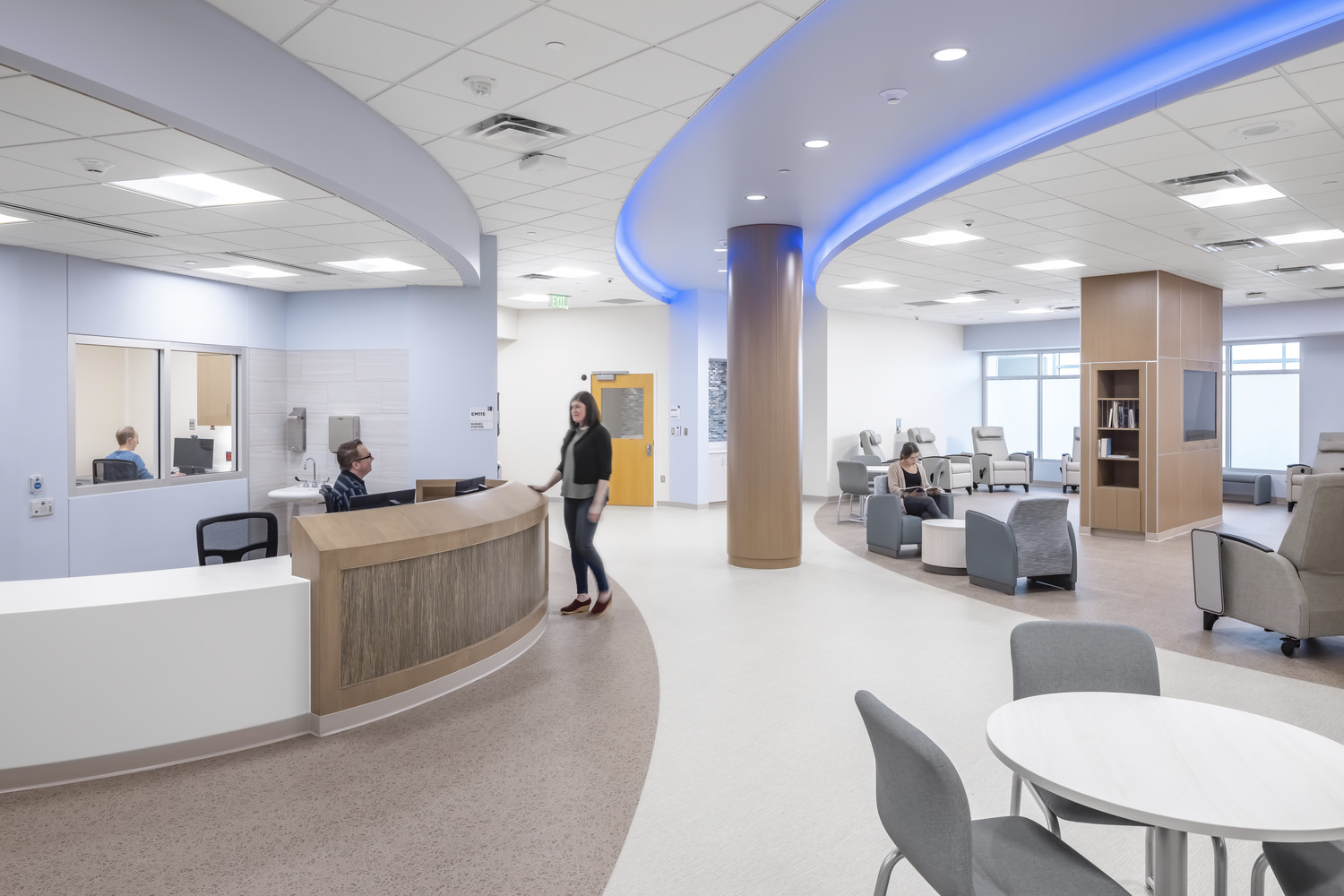
Serving 10,000 people in the first five years, Minnesota’s first EmPATH at Fairview offers a calm, living room-inspired space with comfortable recliners and natural light. | Photo Credit (all): Farm Kid Studios, courtesy of BWBR
By Melanie Baumhover, AIA, LEED AP
Behavioral health systems across the United States are under unprecedented strain. Rising demand, workforce shortages, limited treatment capacity and fragmented care networks have created a system that often responds only after people reach a crisis. Emergency departments have become default entry points for patients with behavioral health needs, while outpatient programs, community services and long-term support struggle to keep pace.
The challenge is not simply a shortage of beds. It is a shortage of connected systems that help people before their conditions escalate.
As healthcare organizations look for solutions, many are expanding inpatient capacity. That investment is important as studies show greater than 60% of American’s live in areas with shortages of psychiatric beds, but it is only one piece of a much larger puzzle. Long-term progress will depend on strengthening the full continuum of care and creating environments that actively support healing rather than merely containing risk.
Behavioral health extends beyond treatment to include prevention, belonging and the preservation of human dignity.
Looking Beyond the Crisis
For decades, behavioral health systems have been organized around intervention. Funding models, reimbursement structures and available resources often favor crisis stabilization and inpatient care over lower-acuity services that could prevent emergencies from occurring in the first place. As a result, many patients and families struggle to find help until their needs become urgent.
Healthcare leaders are embracing a “no wrong door” approach, and many organizations are finding success with behavioral health crisis care models, such as EmPATH, that offer alternatives to traditional emergency departments. While these models have gained significant momentum and are highly valued by patients and families, they are not feasible in every case. We have found they can be particularly challenging in smaller or rural markets where patient volumes or staffing may not support them.

One recently completed project, the Pine Rest Pediatric Center of Behavioral Health, demonstrates how the “no wrong door” approach can work when the conditions are right. Families enter through a behavioral health urgent care program rather than a traditional emergency department, where clinical teams assess needs and connect patients with the most appropriate level of care, whether inpatient treatment, outpatient services or community-based resources. Although this model may not be practical in every setting, it illustrates how stronger front-end access points can improve the patient experience and reduce reliance on emergency departments.
The same facility recognizes that healing extends beyond the individual patient. Family support spaces give parents and caregivers a place to rest, work, gather information and regroup during a difficult time.
Successful systems do not simply ask where patients receive care. They ask how communities can support people before they reach the point of desperation. Creating those systems requires organizations to work together in new ways.
Collaboration Is Becoming a Clinical Strategy
Behavioral health challenges rarely fit neatly within the boundaries of a single institution. Hospitals, county governments, state agencies, community organizations, schools and healthcare providers all serve pieces of the same population, yet many operate independently. In underserved and rural communities, those gaps can leave emergency departments caring for patients who would be better served elsewhere.
In some communities, healthcare systems and public agencies have pooled funding and resources to develop regional behavioral health centers that no single organization could have created on its own. Rather than competing for limited resources, they are building partnerships designed to close service gaps and coordinate care across the continuum. Shared investments and stronger partnerships can create more resilient systems while improving outcomes.
Policy reform also plays a role. Regulations that limit treatment capacity or create unnecessary barriers to care can unintentionally prolong suffering. Expanding access will require not only better facilities, but also greater flexibility in how communities deliver services. Even with stronger systems in place, outdated environments can still work against modern models of care.
Melanie Baumhover AIA, LEED AP, is a Principal with BWBR.
Part II of this article will discuss how buildings designed around dignity, access to nature and connection can aid in treatment.