

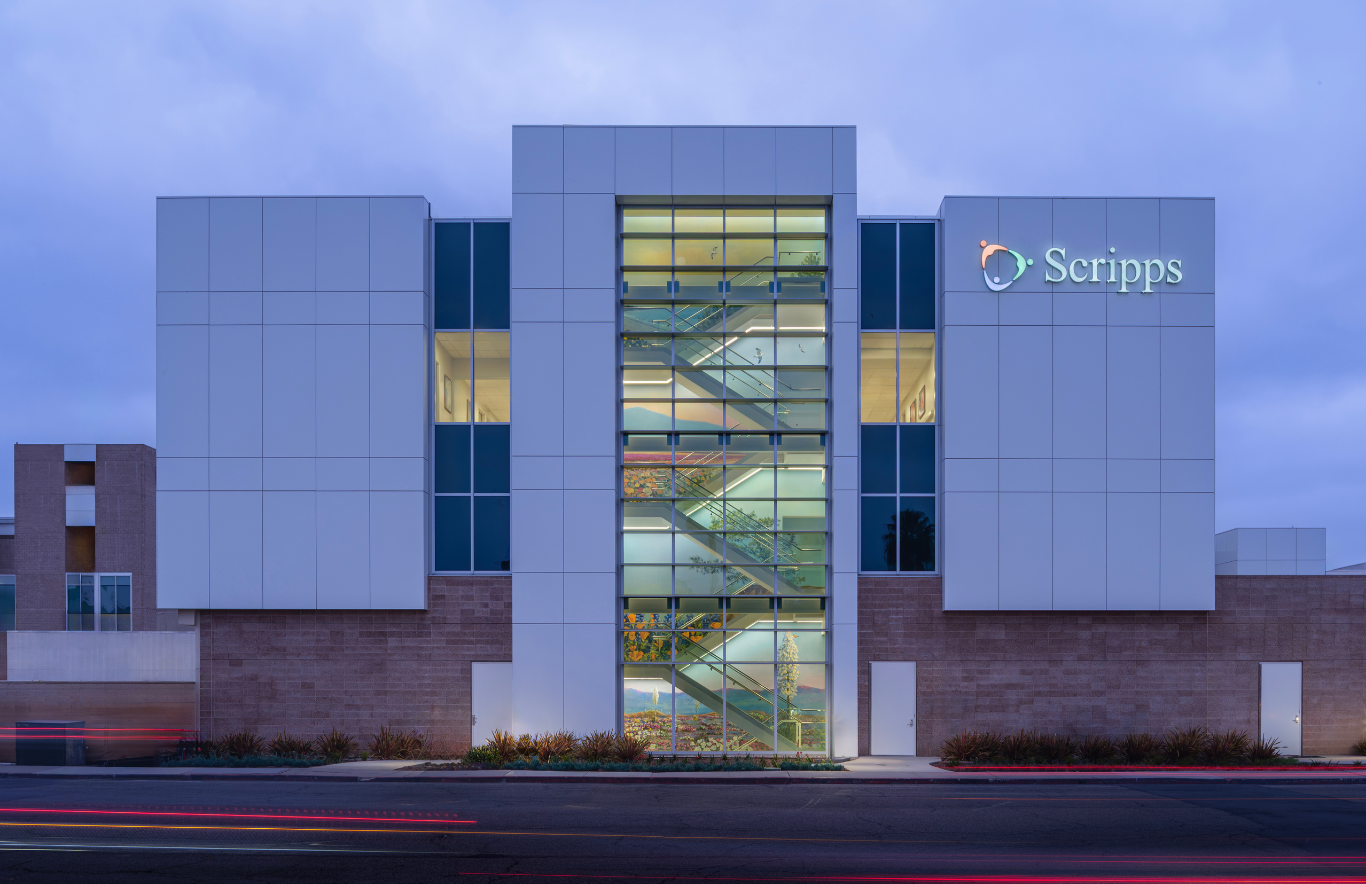
The tower includes 36 private medical-surgical beds, a 16-bed intensive care unit, a 16-bed postpartum unit connected directly to the hospital’s birth pavilion and a 26-bed perioperative unit for patient care and monitoring before and after surgery. | Photo Credit (all): Pavel Bendov, Courtesy of Taylor Design
By Lindsey Coulter
Scripps Memorial Hospital Encinitas has completed the first phase of a long-term campus transformation program with the opening of the new Lusardi Tower, a major expansion designed to increase clinical capacity, modernize patient care environments and support future growth. The three-story, 140,000-square-foot acute care facility serves as a new hub for the campus and represents a significant milestone in Scripps Health’s broader effort to expand access to healthcare services throughout North County San Diego.
Constructed at the center of the hospital campus, the Lusardi Tower brings together acute care services, surgical functions and critical support departments while creating new connections between existing facilities. The project is the first completed phase of a nine-phase modernization and expansion program expected to continue through 2030.
Taylor Design announced the completion of the initial phase, which was carefully planned and executed within the constraints of an active hospital campus. The completion comes as Scripps Health responds to growing demand for healthcare services in the region. The expansion increases the hospital’s licensed bed count from 187 to 235 and introduces new acute care capabilities designed to support a growing and increasingly complex patient population.
“We’re inserting a new hospital into an existing, fully functional facility,” said Bill O’Rourke, project architect with Taylor Design. “Every step was carefully sequenced to keep the hospital running, the project moving forward, and most importantly to allow the hospital to continue caring for patients with the same high level of care.”
The new acute care building adds 36 patient beds and brings together medical-surgical and ICU units, surgical services, and expanded labor and delivery. Additionally, it consolidates laboratory, pharmacy, dietary, and other key support functions.
According to Scripps Health, the tower includes 36 private medical-surgical beds, a 16-bed intensive care unit, a 16-bed postpartum unit connected directly to the hospital’s birth pavilion and a 26-bed perioperative unit for patient care and monitoring before and after surgery. The facility also introduces advanced digital monitoring technology and updated clinical infrastructure intended to support both patient care and staff workflows.
The building was named in honor of philanthropist Warner Lusardi and his late wife, Debbie Lusardi, whose $25 million commitment helped launch fundraising efforts for the project.
Designing for Healing and Connection
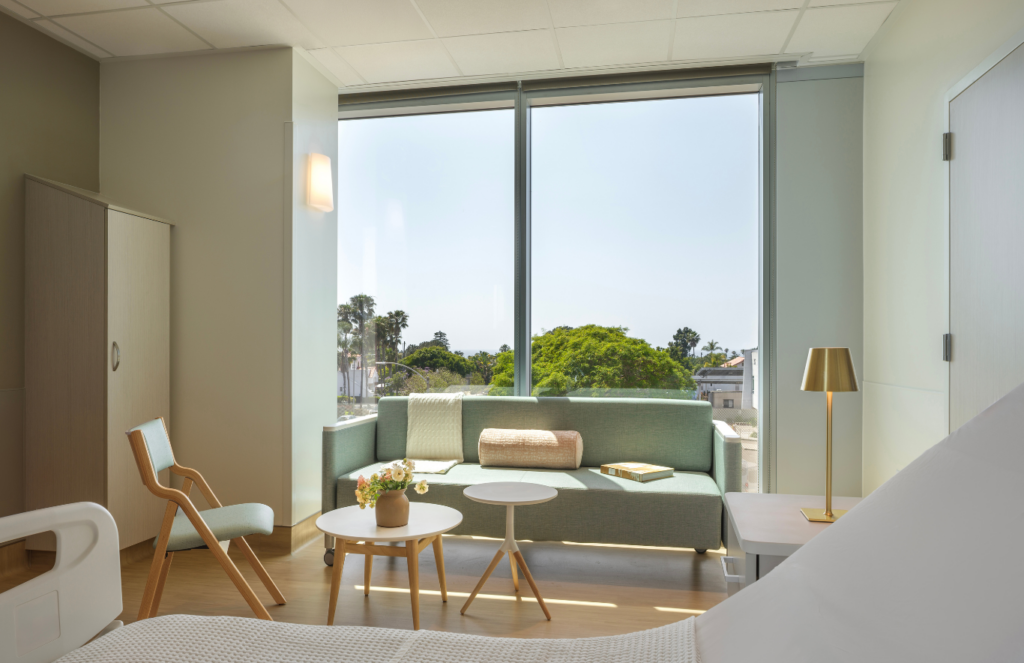
Patient rooms maximize daylight and outdoor views, reinforcing a connection to the surrounding coastal environment. Interior materials and finishes, including warm neutrals and soft blues combined with curated local artwork, contribute to a calming setting while connecting to the diverse communities of Encinitas. In postpartum areas, abstract murals provide visual interest and a positive distraction.
The patient-centered design reflects evidence-based planning principles developed through collaboration among physicians, nurses, administrators, architects and support staff. Private rooms incorporate advanced clinical technology while emphasizing comfort, family involvement and connections to nature through abundant natural light and regional design references.
Centralized nursing stations, articulated through wood-slat ceilings and material changes, anchor each floor. Glass-enclosed physician huddle rooms offer proximity to care areas while supporting administrative needs.
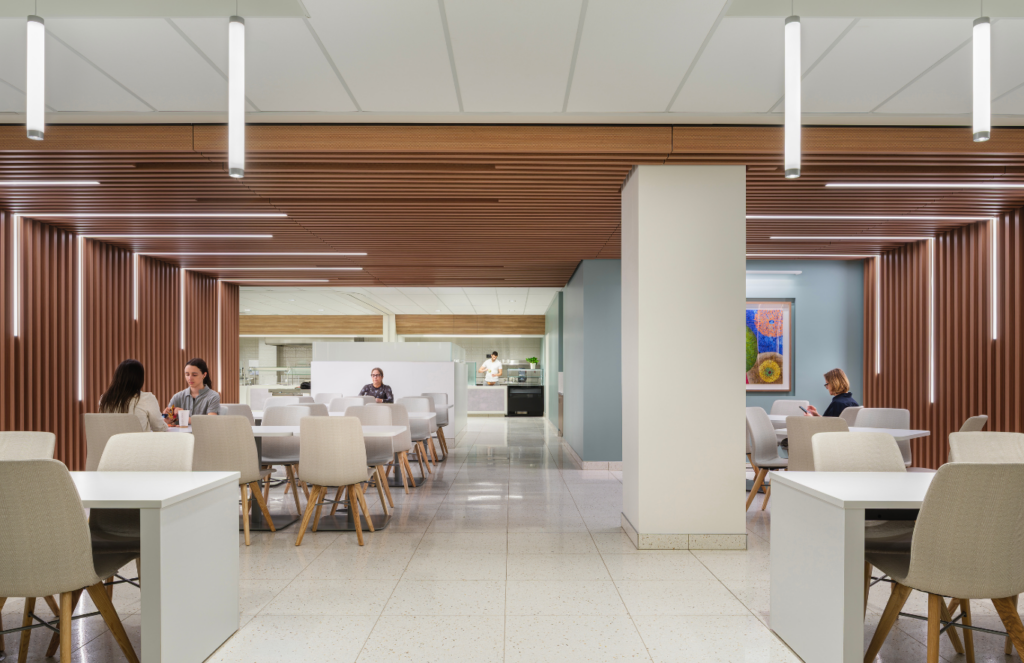
A full-service café adjacent to the campus’ main entry serves as a gathering space for patients, families and staff. A wood portal marks the entrance, creating a wayfinding element and intimate seating alcoves for private conversations.
“In addition to enhancing the patient experience, we considered how to elevate the staff experience. Staff spaces such as break rooms and offices were placed along the window walls to bring in daylight and offer views of the campus,” said Jamison Delfino, principal and lead interior designer at Taylor Design. “A dedicated staff support corridor and coordinated nursing stations allow care teams to move efficiently, outside of patient spaces.”
The emphasis on staff wellbeing aligns with broader operational goals for the facility. Centralized care hubs, visibility between patient and caregiver spaces and strategically located support areas were designed to improve communication and efficiency while maintaining patient privacy.
Building Within an Active Campus
Constructing the Lusardi Tower presented significant logistical challenges because the building occupies a central location within an active healthcare campus. Construction activities occurred alongside ongoing hospital operations, requiring careful coordination to minimize disruptions to patient care.
“Every step was carefully sequenced to keep the hospital running,” O’Rourke said.
Scripps Health noted that demolition, infrastructure improvements and new construction had to be carefully scheduled around clinical operations, requiring extensive coordination among design, construction and hospital teams. The project also complies with California’s seismic building requirements while supporting long-term campus resiliency.
A glass-enclosed stair at the south end of the building, paired with a large-scale mural visible from nearby Interstate 5, serves as a beacon and visual anchor for the campus. The artwork depicts regional landscapes including coastal Torrey pines, North County flower fields and California poppies, reinforcing the project’s connection to the surrounding community.
Long-Term Vision
“The Scripps Encinitas program is a vital project for the region, and we are proud to have Taylor Design as part of our team,” said Whitley Robinson, Scripps Health corporate vice president for facilities, design and construction. “It is no easy task to design and implement a project on an active healthcare campus. We look forward to the next few years as we continue through the next phases of the program.”
Future phases will expand clinical capacity, improve campus circulation and introduce new outdoor spaces, including a landscaped plaza and courtyard leading to a redesigned main entrance.
Scripps Health has also announced a second phase of the Lusardi Tower project, expected to be completed in 2029, that will add new surgical suites, a cardiac catheterization laboratory, interventional pulmonary and radiology suites and expanded imaging capabilities.
The Lusardi Tower builds upon previous investments at the Encinitas campus, including the medical office pavilion that opened in 2021 and the Leichtag Foundation Critical Care Pavilion, which expanded emergency and inpatient services. Together, the projects represent a long-term effort to modernize the campus and accommodate continued population growth throughout the region.
Taylor Design served as the architect-of-record providing architecture and interior design services. Project partners included Rudolph and Sletten, contractor; IMEG, structural engineer; Fuscoe Engineering, civil engineer; P2S, MEP engineering, and Open Air Kanvas, landscape architect.