

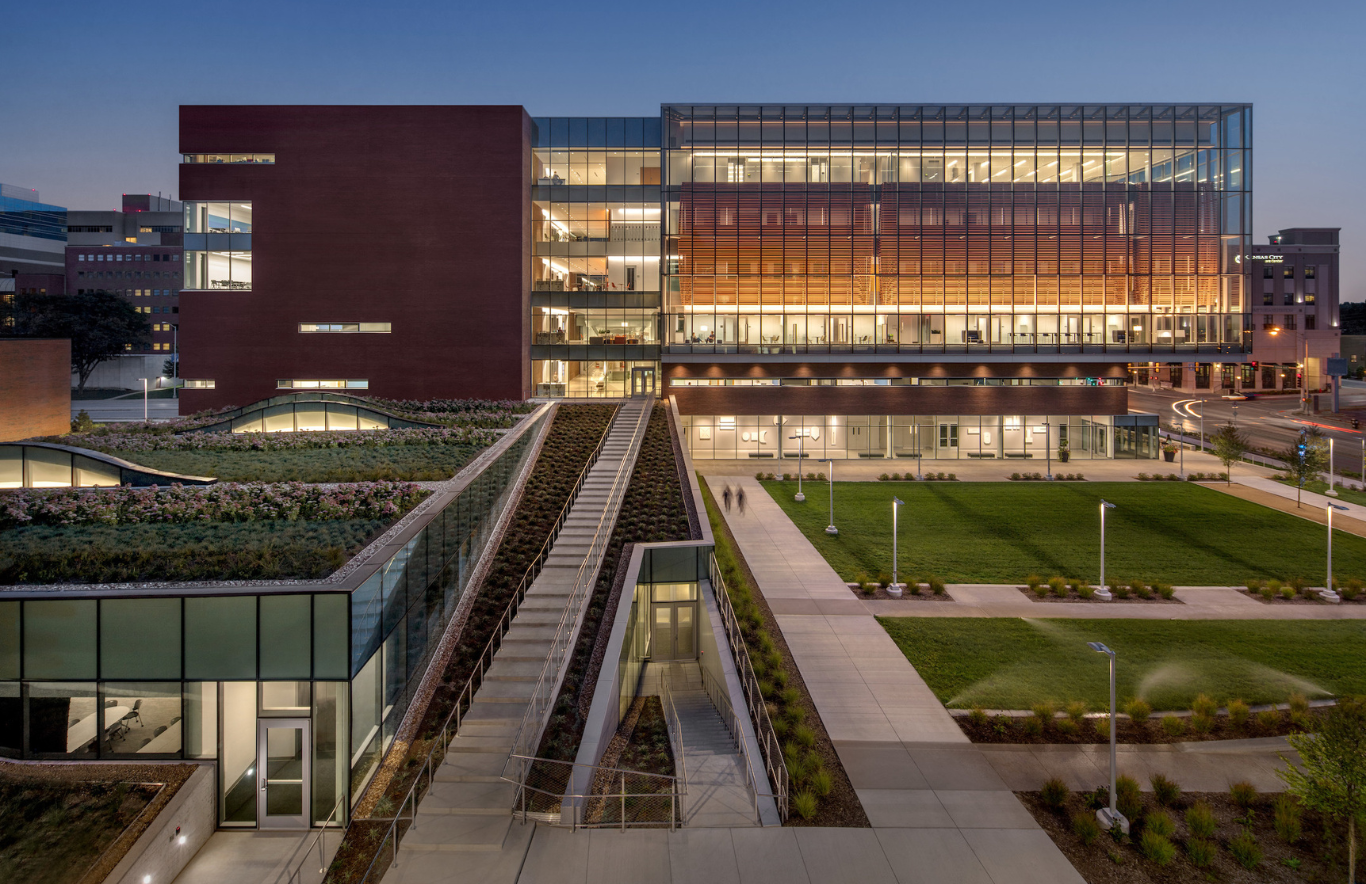
The University of Kansas Medical Center Health Education Building combines performance with visibility and connectivity. | Photo Credit (all): © Bill Timmerman
By Christopher Giovannielli
Healthcare facilities have always been complex to design and build, but today’s environment is introducing a new level of pressure. Hospitals are expected to perform for decades, while the conditions within them change almost constantly. Medical technology is evolving rapidly, patient expectations are shifting and operational demands are expanding. As a result, many healthcare systems are finding that their buildings need to adapt far sooner than originally planned.
In many cases, that means renovations or upgrades begin shortly after a project is completed. In others, it means expansion, from adding floorings and extending wings to building out the surrounding infrastructure. Increasingly, the conversation is about designing a hospital that will last and one that can change in the future.
Designing for Continuous Change
One of the biggest drivers behind ongoing renovation in healthcare is the pace of medical innovation. Equipment used in imaging, robotics and specialized care continues to advance rapidly, often requiring different spatial conditions than originally planned. Rooms that once supported a specific function may no longer accommodate newer systems, either because of size constraints or because the integration of equipment into care delivery has changed.
That reality is pushing healthcare design toward more flexible, standardized approaches. Rather than highly specialized rooms, many facilities are incorporating adaptable layouts that can support multiple uses over time. Wider corridors, larger openings and sliding systems allow for easier movement of beds and equipment, while universal room configurations provide flexibility as patient needs shift.
At the same time, patient expectations are reshaping the design conversation. Today’s healthcare environments prioritize comfort, privacy and experience in ways that were not always standard. Access to natural daylight, open views and more welcoming interiors are becoming essential components of care.
This emphasis on experience is especially evident in projects like St. Anthony Hospital in Gig Harbor, Wash., where the design is rooted in the connection between environment and healing. Located on a wooded peninsula in the Pacific Northwest, the hospital was designed to reflect the natural beauty of its surroundings and support a patient’s journey from illness back to health.
The building incorporates natural light throughout, with an L-shaped layout organized around a central healing garden and additional viewing gardens along the perimeter. A two-story lobby and expansive window walls provide direct visual connections to nature, reinforcing moments of pause, reflection and calm within the patient experience.
These design strategies highlight how healthcare environments are evolving to support overall well-being through light, materiality and connection to place.
Combining Performance Requirements with Experience
Integrating daylight and openness, however, requires careful coordination with building performance.
Hospitals demand strict environmental control, including higher air exchange rates, regulated airflow and careful management of temperature and condensation. Systems must balance patient comfort with operational requirements, particularly in environments with high oxygen levels and sensitive equipment.
Envelope systems play a critical role in achieving this balance. At St. Anthony Hospital, high-performance glazing systems were used to bring daylight into areas that would traditionally be interior or windowless, including waiting rooms and emergency spaces, while still meeting stringent energy and safety requirements.
The University of Kansas Medical Center Health Education Building expands on this idea by combining performance with visibility and connectivity. Designed as the primary teaching facility for the schools of medicine, nursing and health professions, the building showcases a range of high-tech learning environments, including simulation centers, labs and collaborative spaces.
A defining feature of the project is its building-within-a-building concept, where a transparent, glazed “lantern” box surrounds two interior structures. This design allows natural light to illuminate the building while visually revealing the activity inside, reinforcing a sense of openness and engagement across disciplines.
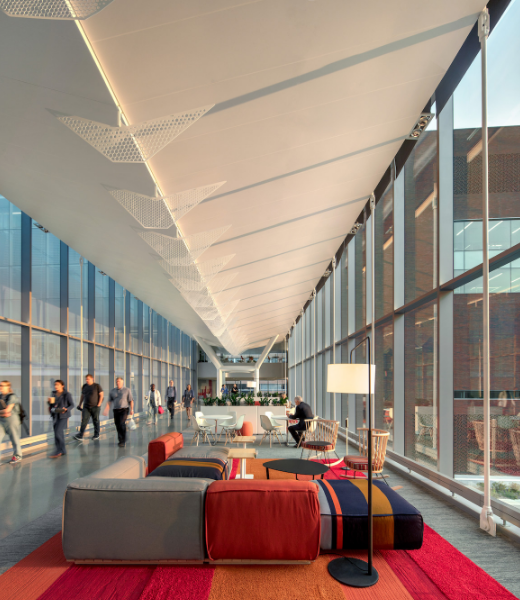
The project also prioritizes connectivity at multiple levels. A glass-enclosed pedestrian bridge spans 250 feet across the site, serving as circulation space and as an extension of the learning environment where students can gather, study and collaborate.
Together, these elements demonstrate how building systems can support both performance and purpose, creating environments that are efficient, adaptable and highly interactive.
From Hospital to Campus
While individual buildings are becoming more adaptable, healthcare systems are also rethinking how facilities are planned at a broader scale. Increasingly, projects are being developed as part of integrated campuses that bring together inpatient care, outpatient services, research and education.
This reflects how healthcare is delivered today. Hospitals are rarely standalone entities. They are supported by networks of medical office buildings, specialty clinics and diagnostic facilities. Planning these components together creates a more cohesive system for both providers and patients.
Campus environments also make it easier to expand over time. Instead of developing new sites, healthcare systems can build on existing infrastructure, adding floors, extending buildings or developing adjacent spaces as demand grows. This allows for more efficient growth while maintaining continuity of care.
Where Research, Education and Care Converge
The integration of research and education is a defining feature of modern healthcare campuses.
Facilities like the Whitehead Biomedical Research Building at Emory University illustrate how research environments are becoming central to healthcare planning. The eight-story, 325,000-square-foot facility is one of the largest biomedical research buildings in the Southeast. It was designed to support advanced research while prioritizing long-term performance and efficiency.
As one of the first LEED-certified buildings in Atlanta, the project incorporates energy- and water-efficient systems, along with high-performance thermal windows that support both sustainability goals and design flexibility. The result is a research environment that meets current demands and can adapt to future needs, reinforcing the role of research facilities within the broader healthcare ecosystem.
The University of Kansas Medical Center Health Education Building further reflects this convergence. Its design does more than support education. It actively showcases this through transparency, shared spaces and circulation pathways that connect students, faculty and healthcare professionals. The result is an environment where learning, collaboration, and clinical insight are closely intertwined.
Planning for What Comes Next
Together, these trends point to a fundamental shift in healthcare design. Hospitals are no longer static assets designed to meet a fixed set of requirements. They are dynamic environments that must respond to ongoing advancements in medicine, evolving patient expectations and long-term growth.
Designing for continuous change requires anticipating future needs, even when they are not fully defined. At the same time, campus development provides a framework for expansion, allowing systems to grow in a more coordinated and efficient way.
The most successful healthcare projects will be those that balance immediate performance with long-term adaptability. By creating flexible buildings within connected campus environments, healthcare systems can better position themselves to respond to whatever comes next.
Christopher Giovannielli is Director of Product Management at Kawneer.