

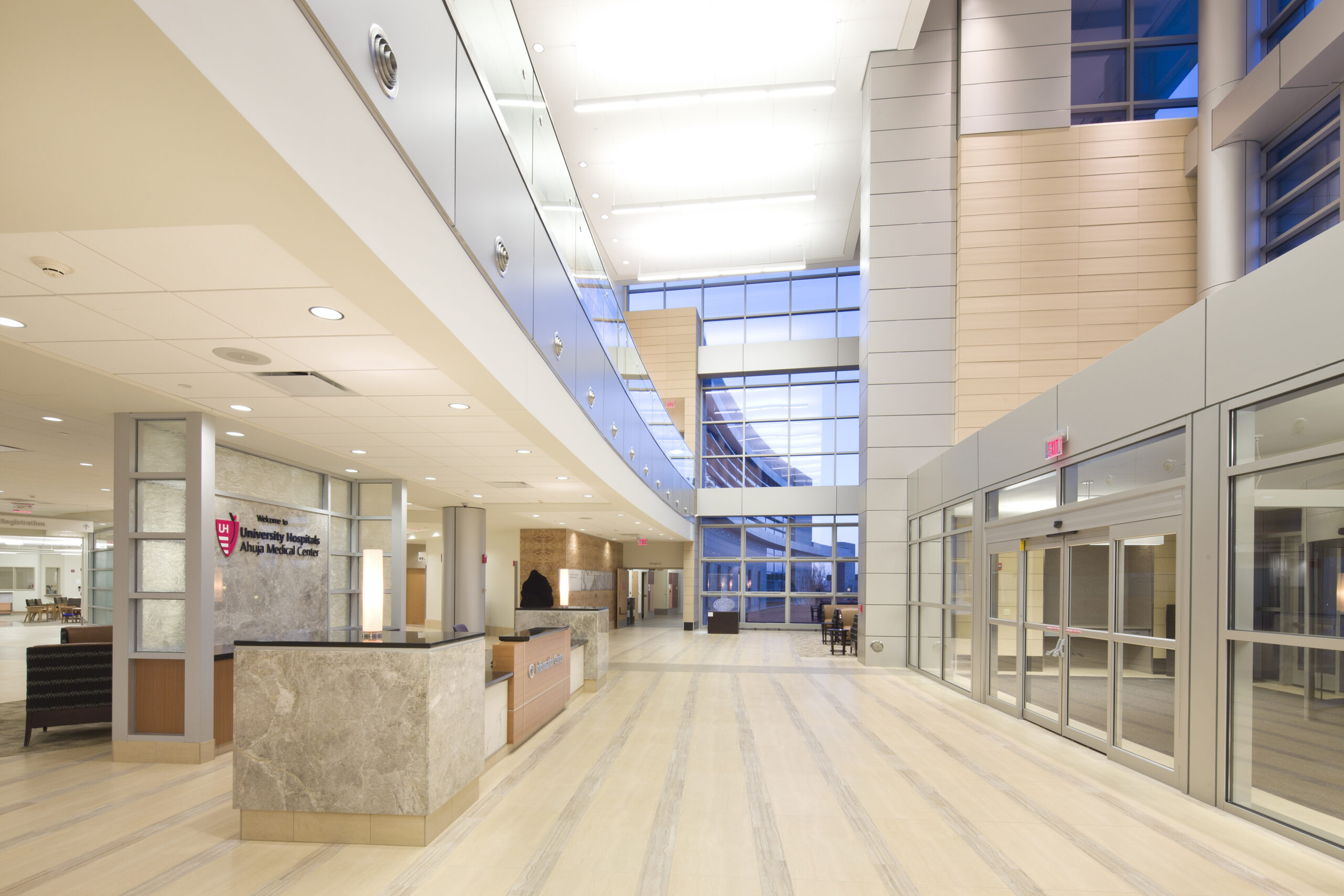
Photo: At Cleveland’s University Hospitals (UH) Ahuja Medical Center, wayfinding is approached as a shared responsibility, supported by digital tools and an active volunteer program. | Photo Credit (all): University Hospitals Ahuja Medical Center
By Percival Kane, Jr., MHA, and Iain Jewitt
In recent years, the healthcare industry has been laser-focused on technological advancements aimed at improving diagnostics, expanding access, and modernizing clinical systems. But amid these efforts, one essential component of the care experience remains overlooked: the design and usability of healthcare environments themselves.
As healthcare becomes increasingly complex as an industry, the physical environment, including how patients and families move through hospitals, how care teams coordinate with each other and how systems communicate spatially, matters more than ever. When infrastructure and digital systems work together intentionally, the result isn’t just improved logistics; it’s a more humanized healthcare experience.
Wayfinding as a Social Determinant of Health

Consider the psychological cost of being lost. A missed appointment due to navigational confusion isn’t just inconvenient for a patient or lost revenue for a provider. That missed appointment can delay diagnoses, increase anxiety, and erode trust in the care process. This is especially true for older adults, patients with cognitive or language barriers, and first-time visitors. In this context, wayfinding becomes more than an amenity; it becomes a question of access and equity.
Healthcare leaders have a responsibility to see venue navigation and design as extensions of their clinical mission. When patients can move confidently through their care journey, it affirms their agency and dignity. As such, hospitals must treat wayfinding like the integral element of venue design it is, rather than a signage project.
A Hybrid Model for Patient Navigation
At Cleveland’s University Hospitals (UH) Ahuja Medical Center, wayfinding is approached as a shared responsibility, supported by digital tools and an active volunteer program. This hybrid navigation model ensures patients receive both intuitive digital guidance and personal assistance when needed. By blending human connection with technological support, UH reduces friction in the patient journey while preserving staff focus and enhancing the overall care experience.
Technology with Purpose
As hospitals explore innovations like real-time location services, indoor mapping, or AI-enabled navigation, it’s critical to resist the allure of technology for technology’s sake. Tools must be inclusive, support human workflows, and remain optional, not mandatory, for patients.
Moreover, these systems must be designed with all patients in mind. That means avoiding replacing warm interactions with cold automation and forgoing the assumption that digital tools will be universally adopted. Equity-centered design demands offering digital support while preserving human connection, especially for those who need it most.
A New Mandate for Healthcare Infrastructure

The future of healthcare design must accommodate flexibility, clarity, and accessibility at scale. Whether in the form of adaptable layouts, dynamic wayfinding, or ambient intelligence, the next generation of infrastructure must be as compassionate as it is capable.
The University Hospitals model reinforces that the quality of care should be congruent with the patient experience. It’s time to elevate infrastructure as a foundational pillar of patient-centered care. Not only with the data we collect, but also within the corridors we walk, the signs we follow, and the systems we build.
Healthcare leaders must widen the lens of innovation. Because where care happens, and how it feels to a patient to get there, matters just as much as what happens once they’re in the room.
Percival Kane, Jr., MHA, is Chief Operating Officer of UH Ahuja Medical Center, where he leads initiatives to improve operational performance, clinical outcomes, and patient experience.
Iain Jewitt is Chief Technology Officer at Purple and has more than 25 years of experience delivering user-centered, scalable digital systems that support service-based industries, including healthcare.