

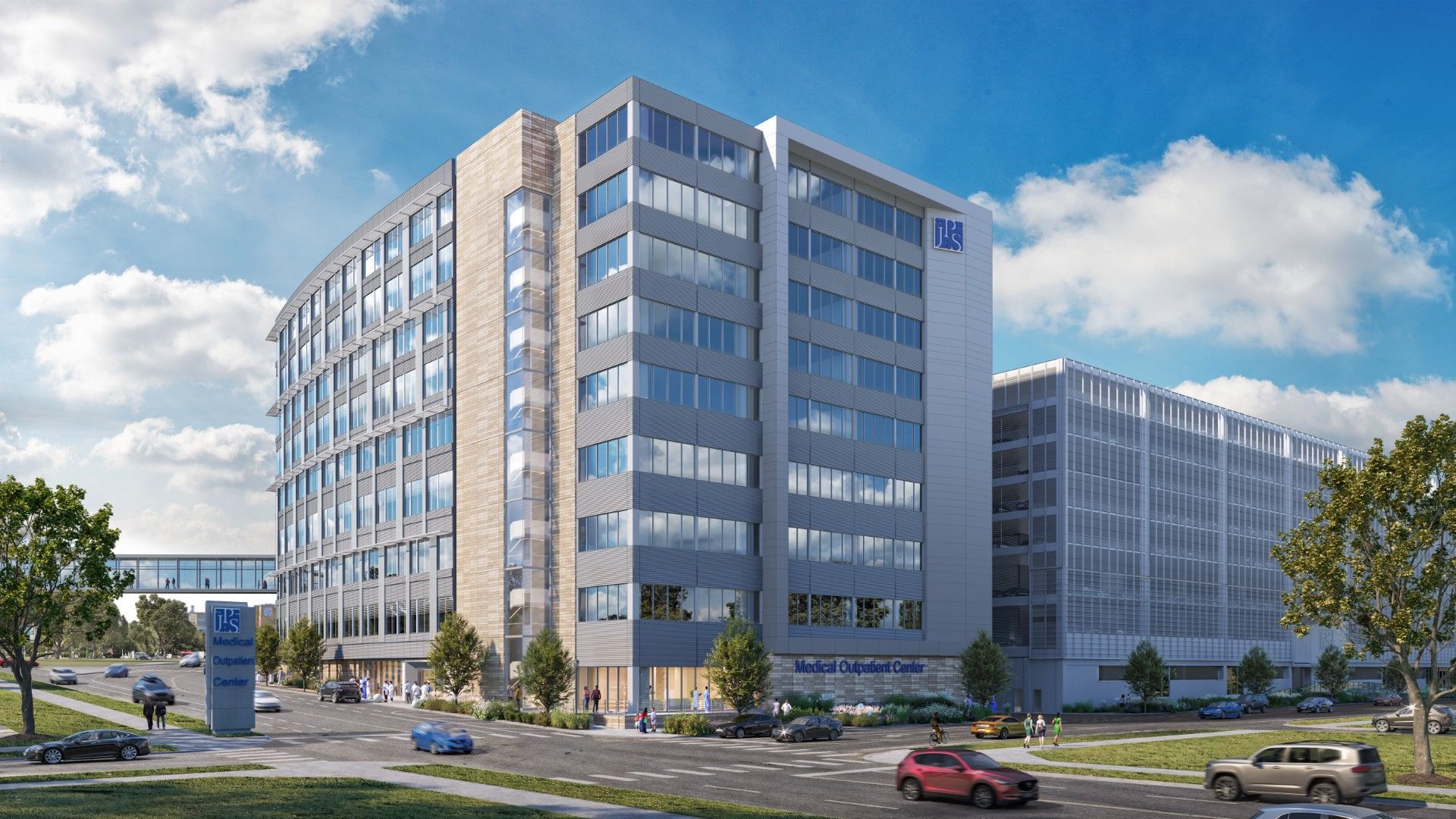
The JPS Health Network Medical Office Building project in Fort Worth utilized a 4-foot modular framework across interior and exterior designs. | Photo Credit: Courtesy of Hoefer Welker
By Jaron Ricketts and Patrick McCurdy
As health systems face rapidly escalating construction costs and persistent skilled-labor shortages, projects must be cost-effective and delivered on time and provide an uncompromising level of quality, now more than ever.
Part I of this article explored how modular and prefabricated construction is quickly becoming a mainstream strategy for healthcare systems confronting rising costs, labor shortages, and tight schedules. By involving fabricators early through an integrated design-assist approach, teams can optimize off-site production, reduce revisions, and streamline delivery — resulting in faster timelines, better quality control, enhanced safety, lower costs and sustainability gains. This shift from traditional, sequential project delivery to collaborative, factory-based fabrication allows health systems to open facilities sooner and with greater efficiency. See these benefits and real-world applications, and continue reading to explore evolving market dynamics, planning strategies and future-proofing healthcare infrastructure.
As an example of this prefabrication model, Hoefer Welker worked in a collaborative partnership with McCarthy Building Companies, Inc. on the CHI Immanuel Family Health Clinic in Omaha, Neb., a 39,502-square-foot project that clearly demonstrated the necessity for speed to market and cost-effectiveness while also addressing labor shortages. Understanding the need to provide an efficient process with higher quality control and strong results, the team explored prefabrication options and ideated several innovative solutions over time to determine what elements would be ideal for prefabrication.
Through multiple design iterations, and collaboration between design and construction partners, the team refined the prefabrication approach to focus on four primary components:
- Under-slab prefabricated plumbing assemblies for rapid, more accurate installation.
- Exterior prefabricated backup wall panels, complete with framing, sheathing and air/weather barriers. To reduce panel weight during transport, exterior finishes were intentionally applied on-site.
- Mechanical overhead rack assemblies, which were installed once the exterior envelope was made weather-tight.
- Interior wall assemblies that integrated electrical systems and in-wall blocking for wall-mounted devices.
Prefabricated plumbing elements were also incorporated into these assemblies and installed on-site. The plumbing strategy was validated through a full-scale mock-up conducted at the Falewitch Construction Services prefabrication facility. These mock-ups confirmed that a hybrid of off-site fabrication at the plumbing contractor’s shop paired with strategic on-site assembly offered the most cost-effective and schedule-efficient solution for plumbing.
The outcome was a refined process that not only streamlined construction but also improved safety, reduced waste, and ensured a higher level of quality control — demonstrating how thoughtful prefabrication can elevate both design and delivery outcomes.
This approach resulted in a schedule savings of nearly three months, approximately 20% faster than the original timeline, and an overall project cost reduction approaching $1 million. The savings included more than $250,000 in material efficiencies, over $500,000 in total construction cost reductions, and additional financial benefit from speed to market, which allowed the owner to generate revenue earlier. Collectively, these factors brought the total estimated savings to nearly $1 million.
Hoefer Welker is also seeing success with the modular and prefabrication process in our current work on the JPS Health Network Medical Outpatient Building (MOB) in Fort Worth, Texas. Speed to market is the main priority for this 300,000-square-foot project, as it provides much-needed services for an entire county. Through the early collaboration for prefabricated and modular design with partners, JE Dunn and Baker Triangle, the project is tracking for a schedule decrease of about six months, largely due to 40-50% faster construction on the building’s skin, resulting in a faster dry-in time. With the project nearing 50% completion, cost savings exceeding $5 million have already been projected for the exterior facade. This is largely due to the prefabrication of nearly 95% of the facade, significantly surpassing the initial goal of 60-70%.
Future-Proofing & Planning
Another benefit of this modular method for health systems is that it allows future-proof flexibility, a key requirement for growing healthcare networks.
The JPS MOB project in Fort Worth utilized a 4-foot modular framework across interior and exterior designs. This ensures that as care needs evolve, the facility is easily adaptable, allowing for the simple swapping of repetitive standardized room sizes for exam, treatment and support rooms without extensive, costly renovation in the future. This flexible strategy has already played out during the later parts of design where the medical staff requested additional treatment rooms in place of some support rooms, avoiding costly redesign and schedule delays.
This new level of flexibility is often made possible by integrating Virtual Design and Construction (VDC) into the modular and prefabrication method. VDC technology allows the project team to simulate construction and think about schedule, scope and budget from the very first phase, maximizing every dollar and minimizing timeline risk. This unified approach integrates fabricators and trade partners into the early stages of design, encouraging technical experts to adopt a more design-oriented perspective and architects to consider technical aspects more deeply. The result is a more efficient and accurate project completion.
As architects, our fundamental role is to safeguard public health, safety and welfare while also fulfilling our clients’ visions. The adoption of modular and prefabricated construction methods achieves that as an effective and efficient healthcare project delivery. The benefits are clear, making this approach an obvious choice for more health systems and projects today and further solidifying it as the future of the industry.
Jaron Ricketts, AIA, NCARB, RAS is an Associate Principal with Hoefer Welker. Patrick McCurdy, AIA, ACHA, NCARB, is a Partner and Regional Healthcare Practice Leader with Hoefer Welker.