

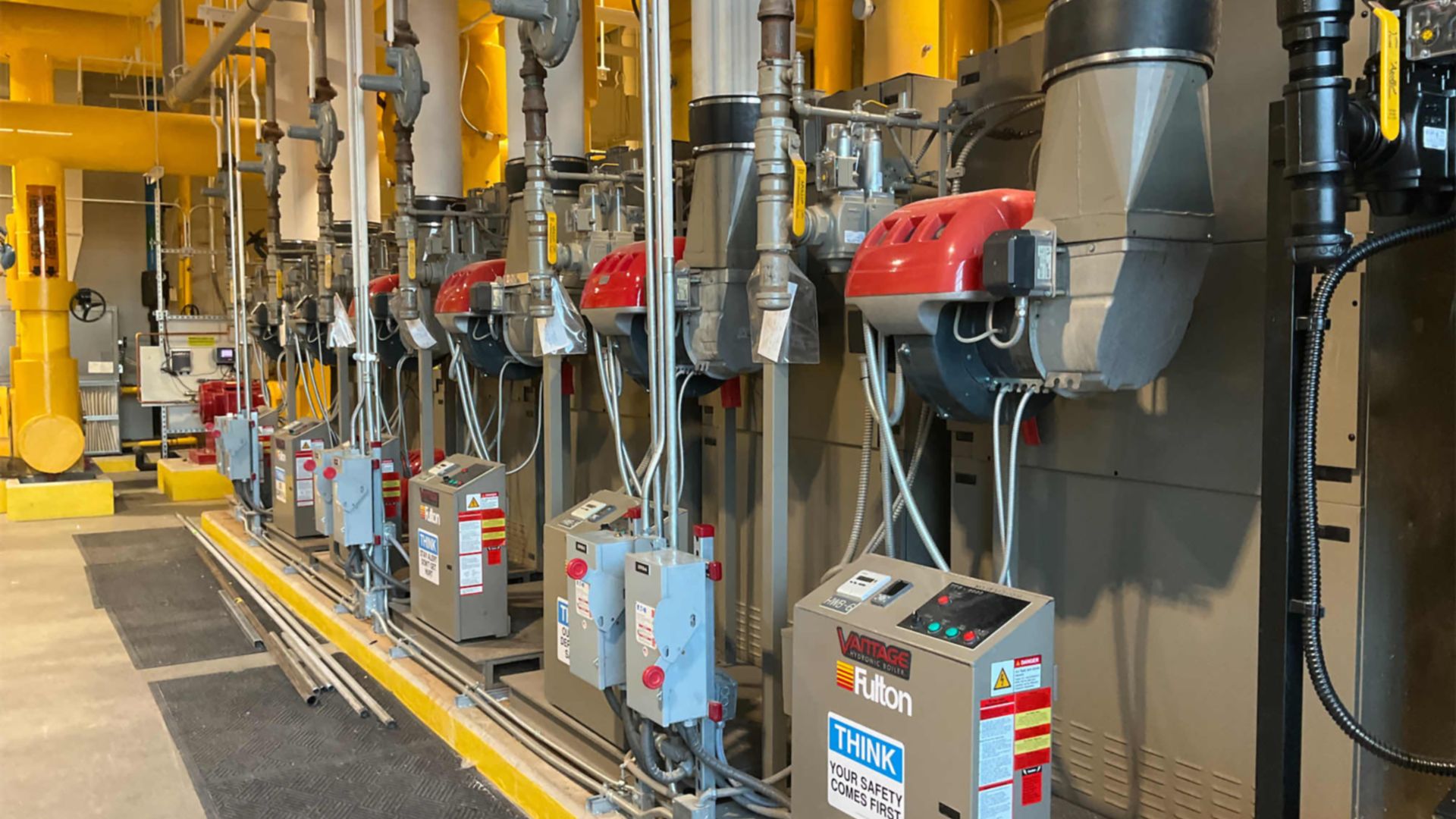
With the right assessments and data-driven modeling, these systems can move from being drains on budgets to drivers of savings, reliability, and healthier environments. | Photo Credit: TLC Engineering Solutions
By Kirk Glazer
This article is Part 1 of a two-part series exploring how central plants can shift from overlooked utilities to high-performing strategic assets.
Across campuses, hospitals, and military installations, central plants quietly hum in the background. They are the hidden powerhouses of buildings, keeping air comfortable, water flowing, and systems running. Yet, despite their critical role, they rarely get much attention. For many operators, the central plant is just another piece of infrastructure that needs to “keep running.”
But that narrow view is costing institutions millions. In healthcare, especially where energy performance is often treated as secondary to patient care, plants are too often managed by overstretched staff with little training, operating in manual mode, and making decisions on the fly. The result? Missed opportunities, wasted resources, and, in some cases, risks to occupant health.
Reimagining the central plant as a strategic asset rather than a background utility changes everything. With the right assessments and data-driven modeling, these systems can move from being drains on budgets to drivers of savings, reliability, and healthier environments. To understand how central plants can become assets rather than liabilities, it helps to first examine the daily challenges faced by the people who run them.
Closing the Knowledge Gap
Walk into almost any central plant and you’ll see the same challenge: operators working with inherited systems they were never properly trained to run. Without a clear understanding of how sequences are meant to function, many default to manual operation. If equipment isn’t breaking down and people aren’t complaining, there’s little incentive to do more.
But keeping systems on manual control is like driving a car in first gear and never shifting—eventually you burn fuel, waste energy, and wear out parts. Operators themselves are often caught in this grind, bouncing from one emergency to the next without time to focus on the bigger picture.
When facilities invest in assessments that show how systems behave, everything changes. Using nothing more complicated than a spreadsheet, project teams can demonstrate the cause-and-effect of sequences, the impact of valve positions, and the savings unlocked by automated controls. Suddenly, operators who once saw automation as a liability begin to view it as a lifeline. Freed from constant firefighting, they can manage systems proactively instead of reactively. Even when operators gain clarity, the cultural mindset of leaving systems untouched if they appear to work presents a barrier to progress.
Beyond “If It Isn’t Broken”
Resistance to change is another major hurdle. In hospitals, especially, where patient safety is paramount, there’s a strong inclination to leave well enough alone. If a plant appears to be working, why take the risk of reconfiguring it?
But “working” can be deceiving. One sprawling plant serving more than 100 buildings, for instance, ran multiple massive water pumps at a set throttle, pushing far more water than needed. The buildings stayed comfortable, but the energy bills told another story. By carefully analyzing bypasses and adjusting valves, the plant was able to reduce flow and slash costs—without affecting comfort at all.
In other cases, central utility plants with chilled water storage tanks charged them at night but didn’t align usage with their actual utility rate structures. They had the right equipment, but without optimization, they were leaving money on the table.
The solution often lies in reframing the conversation. Energy efficiency isn’t about tinkering with systems for its own sake—it’s about reinvestment. Every dollar saved in the plant can be redirected toward new equipment, expanded services, or better patient care. In this light, optimization is not a distraction from the mission; it’s an enabler of it. And when changes aren’t made, inefficiency doesn’t simply remain hidden—it often becomes embedded in the way systems operate day after day.
The Hidden Costs of Inefficiency
Even when facilities are open to improvement, central plants often fall victim to invisible inefficiencies. Pumps run at constant speeds when variable flow would suffice. Chillers are staged in ways that never allow them to operate at their optimal efficiency points. Valves are left partially closed, wasting energy for years without anyone realizing it.
One client invested heavily in a high-efficiency chiller, confident it would deliver major savings. But when the actual load profile was modeled, it turned out the plant rarely operated at the chiller’s most efficient conditions. The premium price tag brought little return.
These kinds of revelations highlight the value of accessible modeling. Using universally available tools, operators can simulate scenarios, compare performance curves, and test schedules against real utility rates. Instead of relying on sales promises or gut instincts, they can make decisions rooted in data. The result is not just better performance, but smarter investments. These inefficiencies may sound small in theory, but real-world assessments reveal just how dramatic—and sometimes startling—the consequences can be.
Together, these challenges show why central plants so often underperform—not because the equipment is inadequate, but because the systems aren’t being operated, aligned, or optimized as an integrated whole. In Part 2, the focus shifts from diagnosing the problem to unlocking the solution: how data-driven modeling and targeted optimization strategies can deliver measurable savings, stronger reliability, and healthier environments without disrupting operations.
Kirk Glazer, PE, CEM, BEMP, is Principal | Project Engineer with TLC Engineering Solutions. He can be reached at [email protected].