

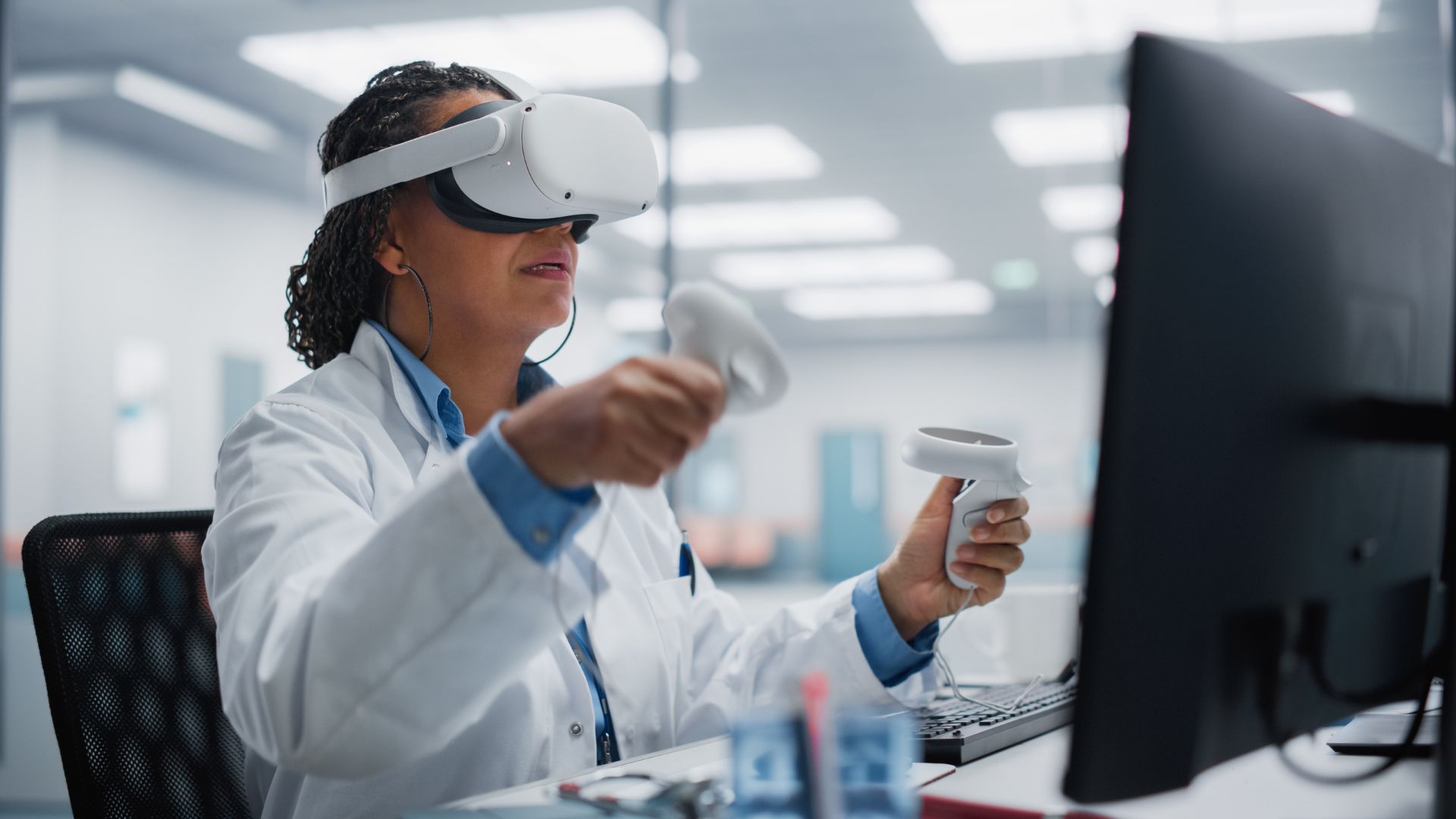
Hardware, network architecture and smart solutions are expanding what is possible within hospitals and beyond with a rate of change that is showing no signs of slowing down. | Photo Credit (all): Courtesy of Verizon Business
By Robin Goldsmith
Digitalization has changed the face of healthcare. Patients can see doctors from their homes. Nurses use microlocation to track down medical equipment. Physicians use AI to identify trends and find anomalies. Hardware, network architecture and smart solutions are expanding what is possible within hospitals and beyond with a rate of change that is showing no signs of slowing down. With that in mind, here are my top five predictions for healthcare technology in 2026.
Virtual Nursing Goes Mainstream
Nursing is a high-touch occupation. Nurses interact with patients, physicians, emergency personnel, administrators, medication and medical equipment. In doing this, they’re often on the move, and nursing isn’t typically seen as a remote job. Technology is changing that. That’s not to say that nursing is likely to go fully virtual any time soon, but aspects of nursing are already being virtualized, to the benefit of nurses and patients alike.
In recent years, we’ve seen IoT technology free up a lot of time for nurses. Historically, nurses have spent significant portions of their shifts tracking down equipment, but IoT sensors connected to medical devices remove that onerous part of their jobs. Nurses can use their tablet or phone to look up the nearest available medical device, freeing them to spend more time on patient care.
This year, camera-based technology will save nurses even more time – enabling them to monitor patients remotely instead of continuously visiting patients and checking their vitals. A command center with remote monitoring capabilities allows nurses to monitor from a distance and respond to call buttons when a patient’s needs arise. This is a more effective way of preventing falls and addressing physiological deviations. This capability can be deployed at scale and goes a long way toward addressing the persistent nursing shortages while maintaining high quality patient care.
AI Transforms Healthcare Delivery
AI tools can improve healthcare outcomes and reduce the administrative burden that consumes a physician’s time. Ambient listening tools, for example, may reduce the “death by a million keystrokes,” which translates to the mountain of clerical work physicians must perform in the era of electronic patient records. These tools capture, summarize and send out salient details during
interactions with patients. Another powerful tool is AI-powered imaging, which streamlines radiology by accelerating imaging and report generation and can assist with identifying abnormalities. As a Mass General Brigham cardiologist recently told me, “It’s the doctors using AI who will thrive, and those who don’t will be left behind.”
The Hospital Extends Into the Home
Technology innovations are reimagining healthcare to the point that we must rethink the concept of a hospital. It’s no longer just a fixed structure with doctors, nurses and gurneys. This emergent connected hospital is a “brain” with tentacles extending out to patients in their homes through wearables, remote monitoring and video-conferencing. A connected healthcare ecosystem will transform diagnostics and proactive caregiving, but most importantly, provide new and different ways to access care.
Wearables as Healthcare’s “Check Engine Light”
Wearables like Oura Rings and CGMs will play a critical role in a connected healthcare system. These devices can collect health-related data, such as heart rate and body temperature, send alerts when falls or other abnormal activities are detected, and capture patient behaviors like physical activity and sleep patterns. By reducing the need for frequent in-person visits, wearables can transform diagnostics and promote proactive care.
Private Networks Become Standard for New Hospitals
Finally, connectivity in healthcare, as with most industries and sectors, comes at a cost: security threats. AI-powered cyberattacks are on the rise, giving threat actors the enhanced ability to scale attacks. Since medical data and patient information are valuable to threat actors, connected hospitals will increasingly invest in network infrastructure that will give them added protection. Private wireless networks, which deliver enhanced security features, greater control over data flow, and increased speeds, will become table stakes for connected hospitals and smart hospitals.
2026 and Beyond—Tensions and Counterweights
This emerging vision of a connected healthcare system can truly revolutionize care, but those involved in designing and creating the components of this ecosystem will have to navigate competing tensions to make it work. Connectivity opens up a host of possibilities, including remote monitoring, enhanced telehealth and remote caregiving, but it must be balanced with heightened cybersecurity and a robust network architecture to support these innovations while protecting patients and caregivers. Telehealth and remote monitoring can make healthcare more accessible to patients in remote areas, but the nation must invest in telecommunications infrastructure to limit “digital deserts” that could effectively prevent the use of such innovations in these places.
It’s always a challenge to balance legacy systems with the rollout of emerging technologies. We should avoid a wholesale rip-and-replace approach that would create instability, but we also owe it to patients and caregivers to make good use of available technologies to design and create better systems. The good news is that we already have all the tools we need to achieve that.
We just have to implement them strategically. It’s not just what we replace. It’s how we replace. The key lies in rethinking how care is provided, while understanding that some things can’t be replaced.
Robin Goldsmith is the Global Practice Leader for Healthcare and Life Sciences at Verizon Business.