


By Lindsey Coulter
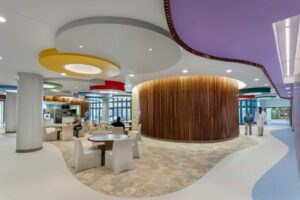
Photo Credit: Joe Aker/HKS
For decades, mental and behavioral health facilities were built primarily for safety and control, often resulting in stark, institutional environments. However, today’s designers, clinicians, and healthcare leaders are creating care environments that balance safety with dignity, compassion and healing.
Healthcare Construction + Operations News first explored this shift in the 2025 Annual Issue Architect Roundtable, speaking with Tiffany Kalloor, associate principal and director of interior design at Hoefer Welker’s Dallas office; Rachael Rome, studio practice leader in mental and behavioral health at HKS; and Marvina Williams, RN, associate principal at Perkins&Will. With combined expertise spanning architecture, interior design, clinical operations, and psychology, these design leaders offered a rich look at the challenges and opportunities in behavioral health design.
While the first part of the conversation focused on evidence-cased design strategies, promoting dignity and autonomy, and balancing patient safety and privacy, read the second part of this insightful conversation to learn about the latest design innovations and how designers are responding to, and helping to advance, progress in patient care.
HCO: How do you plan for long-term adaptability and operational efficiency as care models evolve?
Kalloor: One of the most effective strategies we use is modular unit planning, which allows spaces to be reconfigured over time. For example, in our work with Camber Health, modular planning enabled the units to flex and adapt to shifts in patient populations without requiring major renovations. We also focus on centralizing operational support elements wherever possible. This approach not only streamlines workflow but also helps maximize efficiency in an era where staffing resources are often limited.
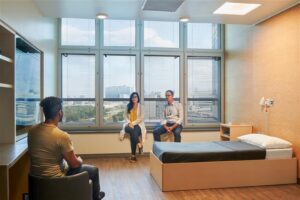
Photo Credit: Joe Aker/HKS
Rome: HKS is really lucky to work with an advisory team, so we have a lot of insight into what the future holds. Between the ICD codes for catchment area today, acuity patterns and those projections, that all tells a story of how we can anticipate the way populations might shift over time. That can include needs related to substance-use disorders or aging populations with neurocognitive decline or really concerning pediatric demand and underserved regions, we can better inform and counsel our clients to make strategic investments that will extend the life of their facilities. That might look like oversizing infrastructure for technology that’s potentially not mainstream or acceptable just yet, like adding cabling to support biometric security or supporting the future of contraband detection at entries or smart access that controls and minimizes some of the really cumbersome procedures for patients and staff to just get to the space they’re trying to go.
Williams: Behavioral health facilities include both inpatient and outpatient facilities. The healthcare industry celebrated the launch of 988, which directed callers to the National Suicide Prevention Lifeline and an influx of patients to facilities. Additionally, there has been an ongoing surge in behavioral health needs from the ongoing waves of COVID that flooded the emergency rooms. Facilities need to be flexible, adaptable and efficient. As designers, we must create areas that can flex for multiple purposes, develop universal rooms that quickly adapt to changes in patient acuity, and devise triage-minded solutions to improve efficiency and reduce wait times for patients and families.
HCO: What innovations in design or materials are improving behavioral health facilities today?

Photo Credit: Dror Baldinger
Kalloor: We are continually integrating innovations that enhance the safety, comfort and effectiveness of behavioral health facilities. One major area of progress is patient empowerment — giving individuals the ability to personalize their environment. Adjustable lighting, for example, allows patients to dim or change settings to suit their comfort, promoting both dignity and autonomy.
Material advancements are also shaping safer, longer-lasting solutions. New certifications, such as the CFFA standard for coated fabrics, ensure that wipeable textiles perform better in demanding healthcare environments. This provides durability without sacrificing safety or design quality.
Rome: We’re seeing a lot of encouraging strides in patient safe products. For a long time, ligature-resistant products were really institutional in nature, but we’re seeing ligature-resistant plumbing accessories and rotationally molded furniture that mimic natural materials. Full door systems now balance the multifaceted needs of patient privacy, staffing round checks, etc., all in one normative package. But I think more exciting than that is the broader manufacturing realm really beginning to recognize that patients deserve better. So we’re starting to see everyday building products like flooring, wall systems, lighting and casework re-imagined through the lens of behavioral health safety.
Williams: Several innovations are improving behavioral health facilities. Surfaces and built-in sensors (e.g., motion, occupancy) can support safety (detect movement or elopement risk) and trigger lighting/ambient changes. Integrating sensors subtly into architecture can aid supervision without creating an institutional feel.
Flexible/responsive lighting (tunable white light), circadian lighting systems and interactive environmental controls (e.g., nodes for color/temperature control) allow spaces to respond to patient states (calming, alertness, de-escalation). Also, AI models can analyze behavioral data, EHRs, sensor feeds or biometric signals to detect decompensation risk or escalate interventions before crises.
AI and VR are great tools and should be integrated into all design projects. They allow clinicians, patients and families to “walk through” proposed spaces and give feedback before construction. They have been utilized on many of our projects, such as the University of Virginia Health System. They have even incorporated our VR capabilities with their medical school to allow medical students to experience different environments from the patient’s viewpoint in the hospital system.