

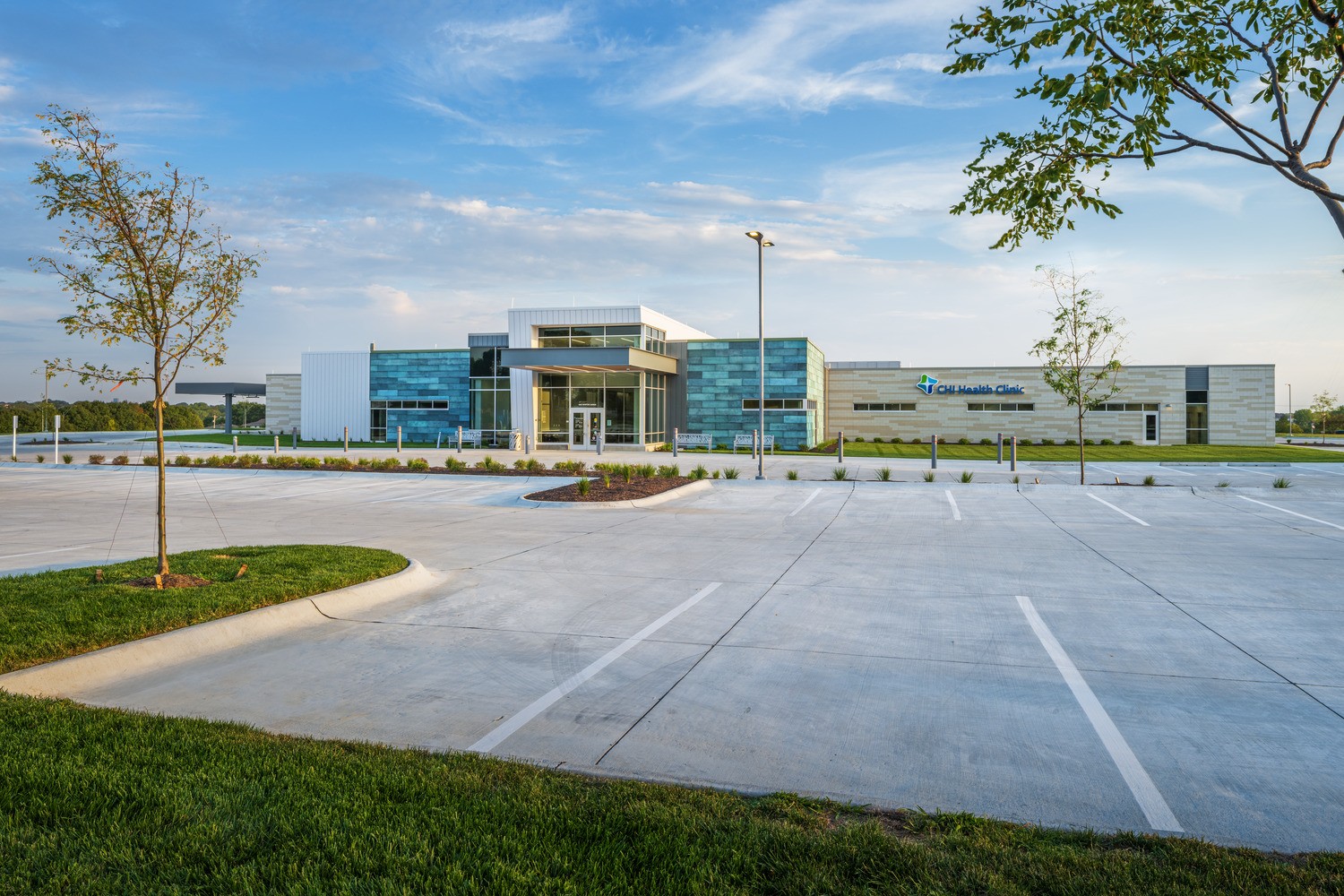
Photo: Hoefer Welker worked in a collaborative partnership with McCarthy Building Companies, Inc. on the CHI Immanuel Family Health Clinic in Omaha, Nebraska, a 39,502-square-foot project that clearly demonstrated the necessity for speed to market and cost-effectiveness while also addressing labor shortages. | Photo Credit: Hoefer Welker
By Jaron Ricketts and Patrick McCurdy
As health systems face rapidly escalating construction costs and persistent skilled labor shortages, projects must be cost-effective and delivered on time and provide an uncompromising level of quality, now more than ever. One approach that Hoefer Welker has seen gain significant traction in meeting all three goals is modular and prefabricated construction, a delivery method that is rapidly becoming mainstream for healthcare facilities nationwide.
Traditional Practices vs. Modular and Prefabricated Solutions
As healthcare architects, we strive to be problem-solvers. While we prioritize clinical flows, improved patient outcomes and elevated patient experiences within our designs, we simultaneously work to identify ways to enhance timelines and provide efficiencies in the design and construction processes.
Traditionally, the design and construction process has been linear and fragmented. The architect develops the design and technical documentation, which is then handed off to a general contractor to bid and build. Fabricators typically join late in the process to interpret the design documents and produce the shop drawings needed to manufacture building components. This sequential, handoff approach — where design, construction and fabrication occur largely in isolation — often leads to inefficiencies, multiple rounds of revisions and schedule delays.
Hoefer Welker has found greater success with a modular and prefabrication method utilizing an integrated design-assist approach, engaging the fabricator as a key collaborator from the earliest project stages. By incorporating their expertise in factory fabrication techniques, the design team can optimize assemblies for production efficiency, minimize shop-drawing back-and-forth and resolve potential conflicts before they reach the jobsite. The result is a smoother, more predictable delivery process that shortens timelines, enhances quality and provides measurable value for healthcare clients.
Why Prefabrication Works: Proven Advantages and ROI
Prefabrication delivers tangible benefits that directly address the industry’s most pressing challenges: time, cost, labor, safety and sustainability. These benefits are evident in the following ways:
- Increased Efficiency and Speed to Market
Components are fabricated in parallel with site preparation and foundation work, drastically reducing total project duration. Fabricating within a controlled indoor environment eliminates weather-related delays and allows for precise scheduling. For healthcare systems, this means speed to market, providing earlier occupancy and quicker access to care for their communities. - Enhanced Quality Control
In a factory-controlled setting, every component is produced under consistent conditions and inspected for accuracy before leaving the facility. Precision manufacturing reduces variability, minimizes rework and ensures a higher standard of craftsmanship. This is vital for complex, highly regulated healthcare environments. - Improved Safety
Off-site fabrication reduces congestion and the number of trades working simultaneously on active construction sites. Workers perform their tasks in ergonomic, climate-controlled environments with less exposure to hazards, translating into safer projects and fewer on-site incidents. - Cost Savings and Resource Optimization
Prefabrication lowers labor costs by streamlining assembly and minimizing on-site hours. Material efficiency improves through precision cutting and automated production methods, which reduce waste and simplify recycling. Faster project delivery also translates to financial benefits, such as owners opening facilities sooner and lower interest, overhead and carrying costs. - Sustainability and Waste Reduction
Factory-based construction significantly minimizes waste, noise and pollution at the jobsite. Off-site assembly of elements such as underground plumbing and wall panels not only reduces field labor but also optimizes material layouts, further enhancing sustainability. Fewer deliveries and shorter build times help lower the overall carbon footprint, supporting the growing demand for greener, more responsible construction practices. - Addressing the Labor Shortage
With the construction workforce aging and skilled trade participation declining, prefabrication offers a practical solution. It shifts a portion of the labor from unpredictable jobsites to controlled manufacturing environments, improving productivity while requiring fewer on-site tradespeople.
A Market on the Move
Healthcare construction has emerged as one of the leading sectors adopting prefabrication due to its need for precision, repeatability and rapid delivery. Once concentrated on the coasts, the approach is now gaining strong traction in the Midwest and other regions, with projects of all scales benefiting from its efficiencies. Every project, regardless of size or complexity, can leverage prefabrication in some capacity, whether through modular mechanical racks, exterior wall panels, or fully integrated room assemblies.
Through various partnerships, we’ve seen the benefits of applying modular and prefabricated strategies to redefine project delivery. Measurable gains have been demonstrated in speed, safety, quality and cost performance across a range of healthcare environments.
As an example of this prefabrication model, our team worked in a collaborative partnership with McCarthy Building Companies, Inc. on the CHI Immanuel Family Health Clinic in Omaha, Nebraska, a 39,502-square-foot project that clearly demonstrated the necessity for speed to market and cost-effectiveness while also addressing labor shortages. Understanding the need to provide an efficient process with higher quality control and strong results, we explored prefabrication options and ideated several innovative solutions over time to determine what elements would be ideal for prefabrication.
From the earliest stages of design, the project team recognized the opportunity to leverage prefabrication to enhance quality, efficiency and consistency. Initial explorations focused on flat-pack interior wall systems, where each component is precut, shipped flat and assembled on-site, much like an IKEA furniture kit. The team also studied various modular strategies, including partial-height walls and panelized assemblies, with an emphasis on identifying repeatable room types that could maximize the benefits of off-site construction efficiencies.
Watch for Part II of this article, featuring more information on market shifts as well as future-proofing and planning, available soon.
Jaron Ricketts, AIA, NCARB, RAS, is an Associate Principal with Hoefer Welker.
Patrick McCurdy, AIA, ACHA, NCARB is a Partner and Regional Healthcare Practice Leader with Hoefer Welker.