


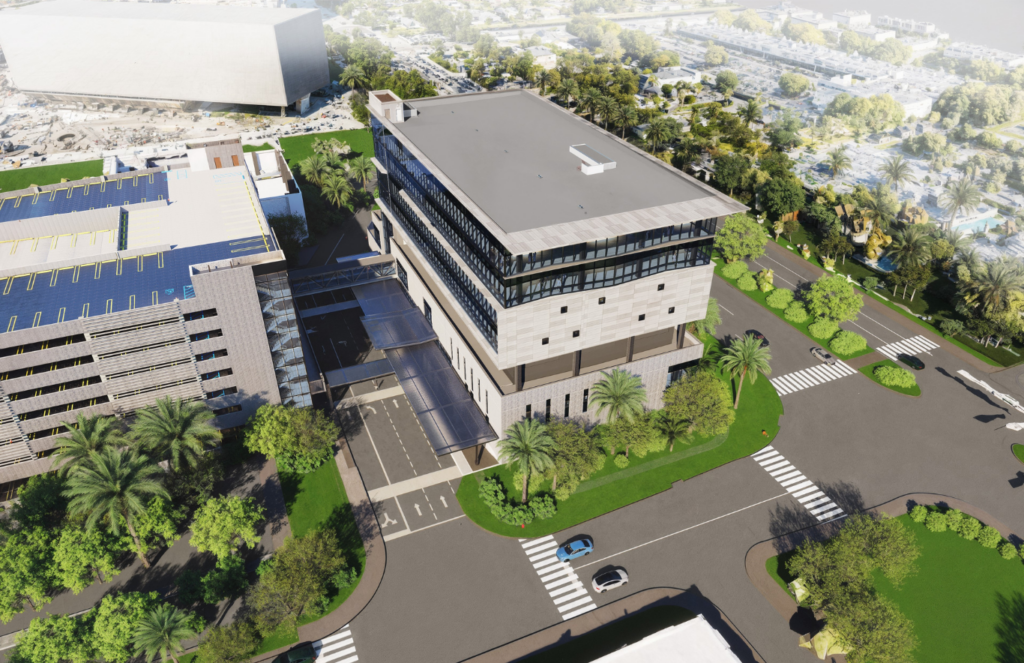
Academic healthcare campuses have always been complex ecosystems where education, research, and clinical care intersect. A clear example of this emerging design approach can be seen at Florida International University’s Herbert Wertheim College of Medicine campus in Miami. | Photo Credit: Stantec
By Arturo Vasquez, AIA, NCARB
Across the United States, universities and healthcare institutions are entering a new phase of transformation driven by artificial intelligence. Academic programs are rapidly evolving to incorporate AI, data analytics, and computational science into fields ranging from medicine and life sciences to architecture and engineering. Yet while educational programs are advancing quickly, the physical environments that support them including campuses, laboratories, and clinical facilities are only beginning to catch up.
For architects and planners, this moment presents a fundamental challenge: how to design buildings and campuses that can support technologies and educational models that are still emerging. The use of artificial intelligence, advanced analytics, and computational modeling technologies is shaping the future of healthcare and research to rethink how academic health campuses are conceived, planned, and built for the future.
A New Generation of Academic Health Environments
Academic healthcare campuses have always been complex ecosystems where education, research, and clinical care intersect. But artificial intelligence is accelerating the convergence of these disciplines. Across the country, universities are launching new programs focused on AI in medicine, biomedical sciences, and computational research. These programs are reshaping not only what students learn but how institutions organize their campuses. Increasingly, universities are looking to create integrated academic health environments where clinical care, research laboratories, data science, and education coexist in a flexible ecosystem.
Many of these organizations are recognizing that the traditional separation between academic facilities, research laboratories, and healthcare clinics is no longer viable. Instead, they are moving toward hybrid environments where life sciences, healthcare delivery, and computational research converge.
This convergence is particularly evident in healthcare education, where artificial intelligence is becoming deeply embedded in diagnostics, patient analytics, and treatment planning. As a result, the physical infrastructure that supports medical education must evolve as well.
Designing for an AI-Driven Future
One of the most significant implications of artificial intelligence for campus design is flexibility. Traditional laboratory buildings were designed around fixed programmatic uses like wet labs, lecture halls, and specialized research spaces. But AI-driven research and digital medicine increasingly rely on computational laboratories, data analysis environments, and collaborative research spaces that evolve rapidly as technology changes.
To address this, flexible building typologies can be developed to adapt between different types of research and learning environments. By using AI-enabled planning tools and simulation software, a model can show how spaces might evolve over time. For example, testing how a laboratory floor might transition from traditional wet labs to computational research environments, or how teaching spaces could support simulation-based medical training. These models allow architects to anticipate future program shifts before construction even begins. Rather than designing buildings for a single purpose, adaptable frameworks are designed that can evolve alongside the technologies and academic programs they support.
Data-Driven Campus Planning
Artificial intelligence is also transforming how universities plan entire campuses. In the past, campus master planning relied heavily on demographic projections and long-term enrollment forecasts. Today, AI-enabled analytics allow planners to analyze vast datasets related to enrollment trends, research funding, healthcare demand, and patient experience.
Predictive analytics are integrated into campus planning to help universities align physical infrastructure with long-term institutional strategy. These models allow us to examine how student populations may grow, how clinical demand may shift, and how new research programs might affect space utilization. By connecting these datasets to architectural planning, institutions can make more informed decisions about where to invest in new facilities and how those buildings should function over time.
A Case Study in Miami
A clear example of this emerging design approach can be seen at Florida International University’s Herbert Wertheim College of Medicine campus in Miami.
The new 120,000-square-foot academic and clinical facility will support the partnership between FIU and Baptist Health South Florida. The building integrates outpatient healthcare services with academic training environments, creating a platform for the next generation of physician education and clinical research. The $162-million project represents more than just a new medical facility. It reflects a broader shift toward AI-enabled academic health environments where data analytics, digital medicine, and medical education operate in tandem.
To support this vision, AI-assisted tools, including advanced rendering platforms and computational analytics are used to prototype building layouts, test workflow scenarios, and explore how the campus may evolve over time. These tools allow the design team to simulate clinical operations, optimize patient flow, and ensure that academic and healthcare functions can adapt as medical technologies evolve.
The Architect’s Role in an AI Era
The rise of artificial intelligence is transforming many industries, and architecture is no exception. But rather than replacing the architect’s role, AI is expanding it. Architects now have the ability to analyze more information, test more design scenarios, and better understand how buildings will perform long before they are constructed. This allows designers to become strategic partners in shaping institutional growth rather than simply responding to predefined building programs.
In academic healthcare, this shift is particularly significant. Universities are competing to attract students and research talent in emerging fields such as AI-driven medicine and computational biology. The campuses that succeed will be those that can rapidly adapt their physical environments to support these disciplines. Architecture therefore becomes part of a larger institutional strategy, helping universities visualize the future of education, research, and healthcare delivery.
From Machines Learning to Humans Learning
Artificial intelligence is often described as machines learning from human data. But in the built environment, the relationship is increasingly reciprocal. Designers are now learning from machines by using computational tools to uncover patterns, analyze data, and explore design possibilities that were previously impossible to see.
For academic healthcare campuses, this partnership between human creativity and machine intelligence is opening a new frontier. The next generation of medical campuses will not simply house classrooms and clinics. They will operate as dynamic environments where students, physicians, researchers, and data systems interact continuously.
And as artificial intelligence reshapes how we learn, teach, and deliver healthcare, architecture must evolve with it, transforming campuses into living systems designed for discovery, innovation, and better patient care.
Arturo Vasquez, AIA, NCARB, is Design Principal and Senior Architect, Stantec in Miami.