
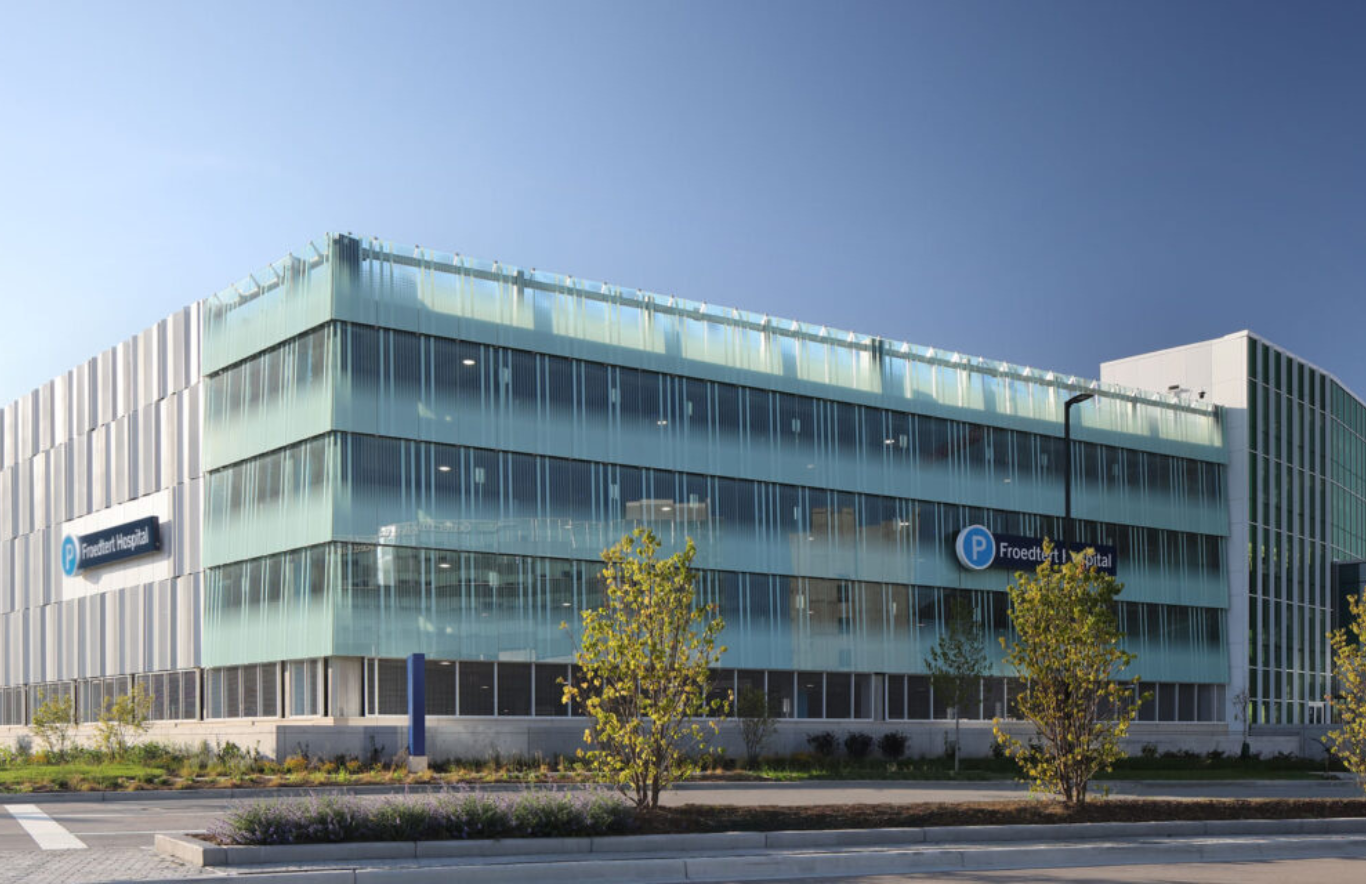
Bendheim’s custom glass façade for Blue Parking Structure enhances both light and wayfinding across the campus. | Photo Credit (all): Tricia Shay Photography
By David Groth
Healthcare organizations often focus on designing welcoming lobbies and patient-centered care environments. But for many visitors, the first impression happens long before they reach the front door. At the Froedtert & the Medical College of Wisconsin health network campus in Wauwatosa, Wisc., that first impression now begins in the newly completed Blue Parking Structure. The six-level, 2,274-space facility is designed to do more than store cars.
Part of a broader campus expansion, including a nine-story, 225,000-square-foot patient tower, the Blue Parking Structure replaces aging public parking while setting a new standard for healthcare infrastructure. EUA and our partners, American Design, Bendheim, CG Schmidt and GRAEF, worked closely with Froedtert to ensure the structure not only functions efficiently but also communicates the hospital’s values of transparency, care and community connection.
Reduce the Number of Decisions
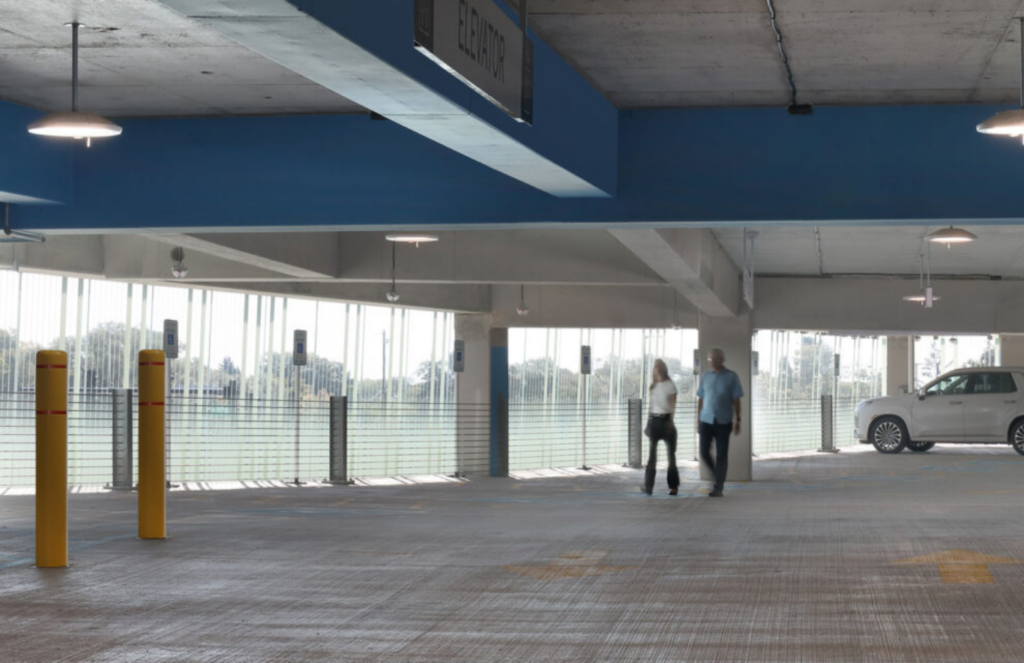
One of the most common issues with parking structures is stress and decision fatigue. Drivers must quickly determine where to go, which level they are on and how to reach elevators or skybridges.
In healthcare parking, it’s especially important to make the navigation clear so people aren’t getting flustered or lost before their appointments. We made all the decks flat, so there are no sloped parking areas. You only go up and down on ramps at one end, improving sightlines and simplifying circulation.
Each level mirrors the others, allowing visitors to quickly understand the layout and locate elevators or the skybridge. Stair and elevator lobbies were intentionally designed as public-facing, daylight-filled spaces, creating a welcoming first impression that aligns with the hospital’s broader branding.
Daylight and Glass as Wayfinding Tools
Wayfinding in parking structures is often treated as a signage problem, but the Blue Parking Structure demonstrates how the building itself can guide visitors. Approximately 10,000 square feet of custom gradient Bendheim ventilated glass faces the new hospital tower and entry, allowing natural light to flood the deck and draw visitors toward elevators and the skybridge.
The gradient fritted glass both echoes the surrounding hospital tower and enhances the building’s aesthetic appeal while serving as bird protection. Beyond its visual refinement, the glass allows natural light and airflow to permeate the structure, creating a bright and comfortable environment while lowering costs of lighting and ventilation. At the same time, the façade establishes a clear visual connection to the campus, helping the parking structure feel fully integrated into Froedtert & MCW Hospital’s health network rather than a standalone utility.
Integrating Technology, Safety and Sustainability
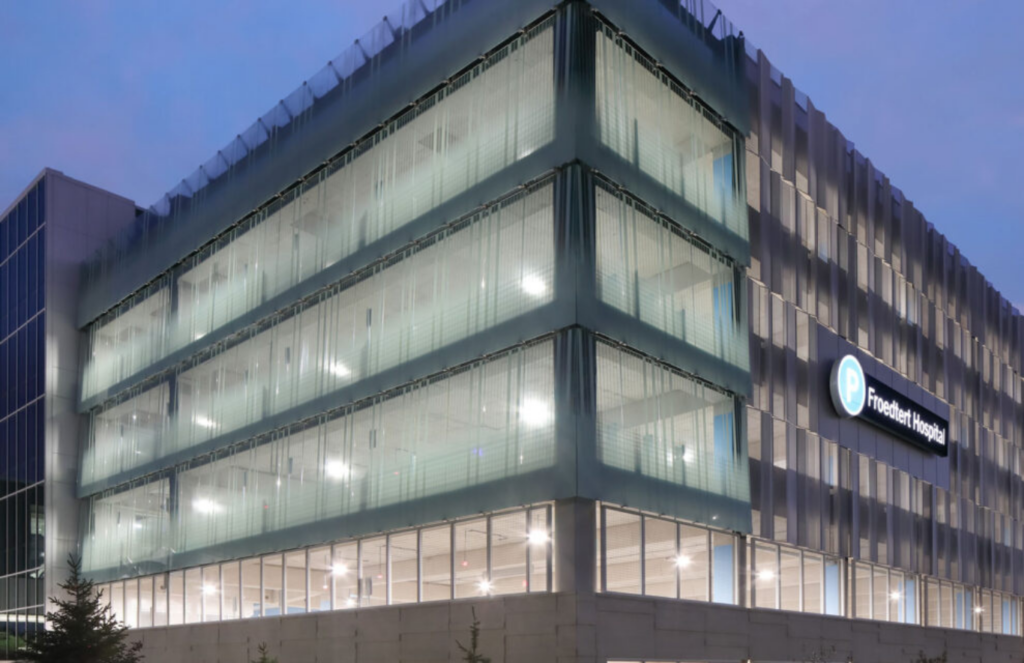
Bendheim’s early design-assist support was critical to the project. By refining the glass panel attachment system, the team reduced the number of clips and streamlined installation. The glass façade is complemented by 44,550 square feet of custom patterned perforated metal panels, crafted by American Metalcraft and finished in Sherwin-Williams bone white. The materials were selected for low maintenance, durability and a projected 75-year service life, supporting long-term operational efficiency while maintaining high design standards.
Beyond aesthetics, the garage integrates advanced technology, including dynamic vehicle guidance signage, access control, car counting systems, snow-melting system and 10 electric vehicle charging stations. Other, more passive safety measures, such as extended parapets and integrated rooftop fencing, enhance security.
Lessons for Healthcare Design
Parking structures are not just functional, they are an extension of the hospital’s care philosophy. By making the arrival experience clear, safe and welcoming, the garage enforces the hospital’s commitment to patients from the very first step. By emphasizing intuitive circulation, daylight and high-quality materials, the Blue Parking Structure transforms a utilitarian necessity into a welcoming gateway for patients, family and staff.
As healthcare campuses evolve, every touchpoint from the garage to the lobby can reinforce a patient-centered experience. Thoughtful design ensures that even the parking experience reflects the hospital’s commitment to care. The Blue Parking Structure stands out as a model for hospitals nationwide seeking to merge functionality, sustainability and patient-centered design in every aspect of their campus.
David Groth, ACHA, is a senior design architect and associate at EUA in Milwaukee, specializing in healthcare architecture and medical planning.