

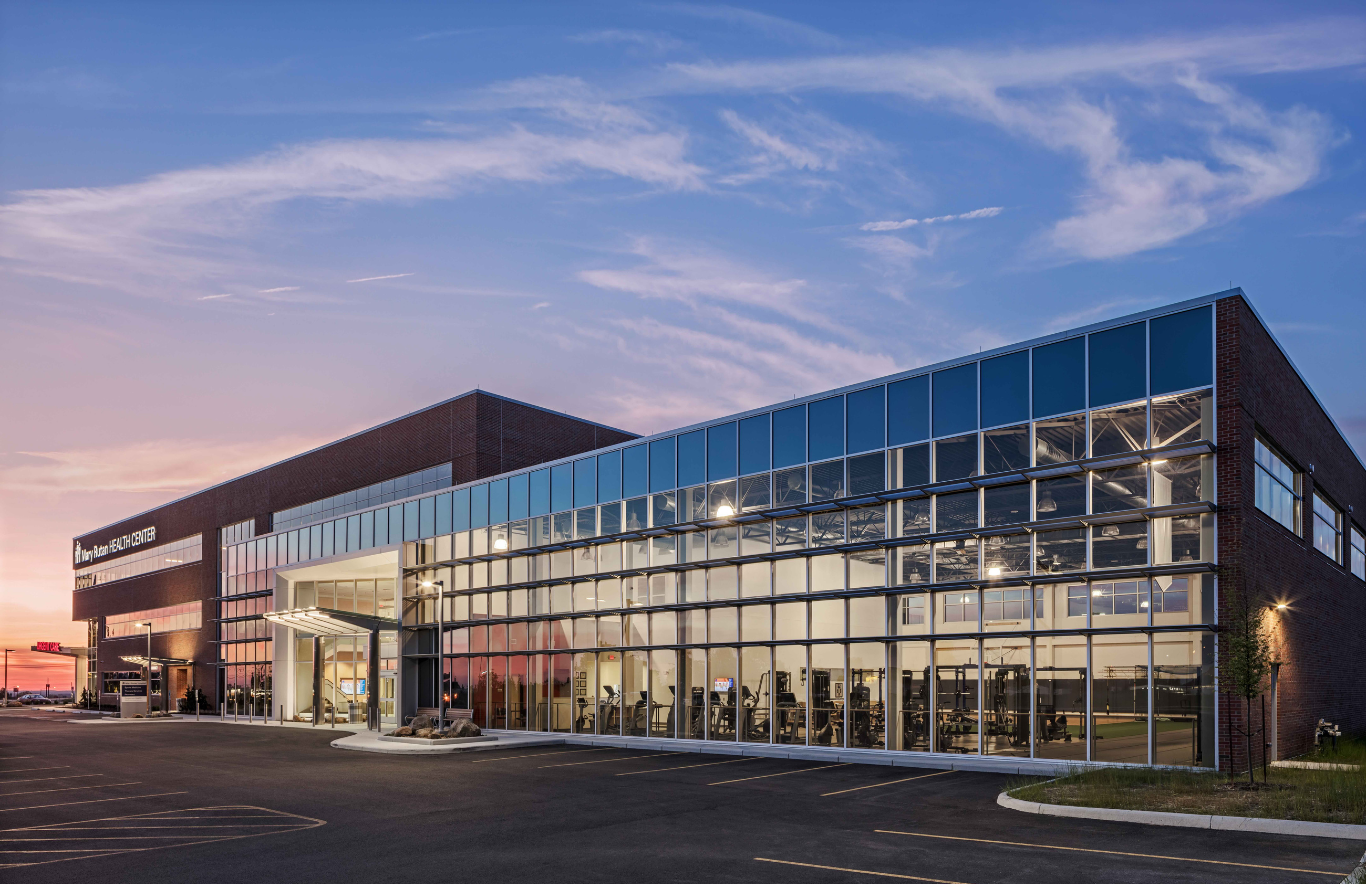
The Mary Rutan Medical Office Building Urgent Care facility completed by DesignGroup. | Photo Credit: Cory Klein Photography
By Lindsey Coulter

Architecture and design firm DesignGroup recently expanded into Indianapolis to serve the state’s growing healthcare, higher education and science and technology sectors. Key to that expansion is Raun Love, DesignGroup’s first hire for its Indianapolis team. A nationally recognized design leader with more than 25 years of experience delivering complex, large-scale projects, Love was appointed senior project manager.
Love previously served as a principal and healthcare practice leader at Indianapolis-based Meticulous, where he played a key role in overseeing the $2.3 billion Indiana University Health downtown hospital project in collaboration with Curis Design, as well as the 97,000-square-foot renovation of the Health & Hospital Corporation Headquarters. His portfolio includes large-scale work with multibillion-dollar health systems, major academic institutions, and civic-oriented projects across the country. A graduate of Ball State University, Love serves as president of the National Organization of Minority Architects and is a board member of the ACE Mentor Program of Indiana.
Healthcare Construction & Operations News (HCO) spoke with Love about the move to DesignGroup and how his experience as a design leader and project owner shapes his approach and vision.
HCO: What factors make Indianapolis a strategic location for DesignGroup’s health care practice right now?
Love: DesignGroup brings more than 50 years of proven experience delivering successful healthcare projects in Columbus—a city comparable in scale and character to Indianapolis. Like Columbus, Indianapolis understands that a community thrives when strategic investments are made in healthcare and life sciences. The city is anchored by nationally recognized institutions such as Indiana University Health and Eli Lilly and Company, whose contributions extend beyond patient care and research to meaningful economic impact across the state. As these and other organizations continue to expand in response to population growth and rapid medical advancement, DesignGroup is eager to partner with healthcare systems, universities, and research institutions to help shape a healthier, more resilient Indianapolis.
HCO: What types of health care projects do you expect will drive the most demand in Indiana over the next decade?
Love: What makes healthcare especially compelling is its constant evolution—driven by both changing population needs and rapid technological advancement. In Indianapolis, we see growing demand for behavioral health services, outpatient and ambulatory care, as well as life sciences and biotechnology facilities. Expanding access through digitally enabled healthcare environments also creates new opportunities to reach Hoosiers in rural and underserved areas, improving equity and accessibility across the state.
HCO: You helped oversee the $2.3 billion downtown hospital project for Indiana University Health. What were the most important lessons from a project of that scale?
Love: I was fortunate to work on a project of that scale and to collaborate with the many talented teams at IU Health, Curis Design and Wilhelm/Gilbane. This once-in-a-lifetime opportunity was deeply formative, shaping not only my approach to healthcare design but also strengthening me as a professional across all project types. The experience reinforced several key lessons:
- Hospitals are operational systems, not just buildings. Every design decision must be evaluated for its operational impact—not solely for aesthetics or spatial efficiency.
- Clinical workflow drives good design. Engaging clinicians early and listening carefully helps avoid costly redesigns and leads to more effective outcomes.
- Coordination is the greatest challenge on mega-projects such as the IU Health New Downtown Hospital. Successful healthcare design relies on rigorous coordination, clear documentation and consistent communication.
- Flexibility is critical, because change is inevitable. Designed during the COVID-19 pandemic, this project required decisions that prioritized resilience and long-term adaptability for unknown future needs.
- Evidence-based design matters. Thoughtful healthcare environments can positively influence patient outcomes and staff performance.
- Stakeholder management is a core design skill. Effective designers act as facilitators and translators, balancing diverse and often competing priorities.
- Design has a real human impact. This project is creating lasting ripple effects throughout Indianapolis and served as a catalyst for the Indy Health District. With that influence came a profound ethical responsibility—to support healing not only for patients but for the surrounding community as well.
HCO: You’ve worked both as a design leader and on the owner side with Eskenazi Health. How does that dual perspective influence how you approach projects today?
Love: I have been fortunate to gain experience that bridges both design and operations, shaping a more practical and operationally grounded approach to my work. I begin every project with operations in mind, asking questions like How will this space be maintained? How easily can this system be replaced in ten years? I prioritize serviceability, access, and durability—not just appearance. With an understanding of the owner’s financial perspective, I focus on design solutions that are economically sustainable over the long term. Healthcare projects involve many voices—physicians, nurses, facilities staff, administrators, and designers—and I have learned to serve as an effective translator, aligning the language, priorities and needs of each group.
HCO: What do health system executives most want from their design and construction partners right now?
Love: Healthcare executives face unprecedented complexity. These include cost certainty and financial discipline, speed to market, and strategic thinking that extends beyond design alone. Operational efficiency, future flexibility, technology integration, and enhanced patient and staff experience are all critical considerations. Leaders also need partners who understand hospital operations, can address aging infrastructure, and are committed to true collaboration throughout the life of a project.
HCO: How is the concept of wellness influencing the design of hospitals and outpatient facilities today?
Love: Indianapolis has embraced a unified vision for health and well-being—one that supports a healthier, more vibrant community. Investments from anchor institutions such as IU Health, alongside nonprofit partners like the Indy Health District, are addressing the social determinants of health and strengthening outcomes across the city. The IU Health campus was intentionally designed as a true health district, integrating medical care, wellness programs, green space, housing and community services into a connected environment.
HCO: What role do adaptability and future-proofing play in modern healthcare facility design?
Love: Hospitals represent a major capital investment, often expected to serve communities for 40 to 60 years. Yet medical technology, care delivery models, and patient expectations can shift dramatically within a single decade. As a result, health systems increasingly demand facilities that can adapt without costly renovations or operational disruption. Rather than treating hospitals as static buildings, forward-looking healthcare architecture approaches them as flexible, evolving systems—capable of continuously supporting new treatments, technologies and models of care.