


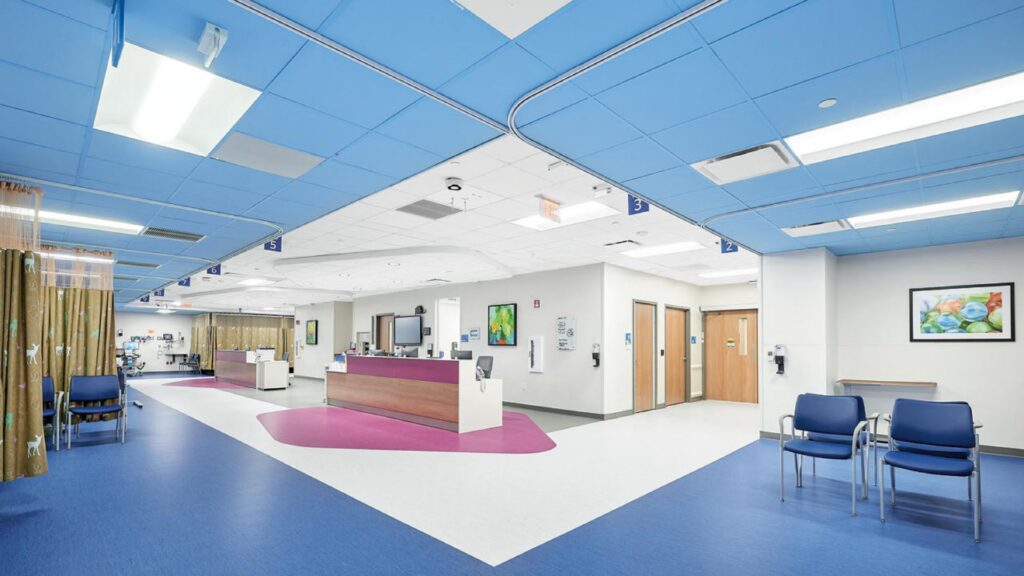
The UF Health Shands Inpatient Dialysis Suite in Gainesville, Fla. | Photo Credit (all): Courtesy of Armstrong World Industries
By Kelsey Herring
Healthcare leaders in 2026 are navigating a perfect storm: persistent staffing shortages, rising operational costs and mounting budget pressures. At the same time, the physical environments where care is delivered are being pushed to their limits. Energy use—long treated as a fixed cost of doing business—is now emerging as one of the most influential factors shaping healthcare facility performance, resilience and long‑term viability.
The Energy Costs of Around‑the‑Clock Care
Healthcare facilities are among the most energy‑intensive building types in the United States, and for good reason: patient care doesn’t stop at 5pm. According to the US Energy Information Administration’s most recent Commercial Buildings Energy Consumption Survey, healthcare buildings account for roughly 9% of all energy consumed in the commercial sector. Their mean major fuel intensity (193.3) is nearly triple that of office buildings (65.6), underscoring the unique demands of clinical environments.
For facility executives, this level of consumption represents a substantial and growing operational burden. Every dollar spent on utilities is a dollar not available for staffing, technology upgrades or patient services. As utility rates continue to rise, energy performance is no longer simply a sustainability metric—it is a strategic business priority.
Investments in high‑performance building envelope systems, HVAC optimization, advanced ventilation strategies, LED lighting and materials that support thermal and acoustic efficiency can significantly reduce consumption. Over time, these improvements help healthcare organizations redirect resources away from energy spend and toward mission‑critical needs.
Energy Availability: A Growing Risk to Care Delivery
Cost is only one dimension of the energy challenge. Reliability is quickly becoming just as critical.
Extreme weather events, combined with rapid growth in energy‑intensive industries like data centers, are placing unprecedented strain on the electrical grid. The North American Electric Reliability Corporation’s 2025 Winter Reliability Assessment warns that large portions of the continent face elevated risk of insufficient energy supply during extreme conditions—demand has already increased by 20 gigawatts since 2024.
This strain is layered on top of an aging grid infrastructure. The 2021 Texas grid collapse remains a stark reminder of how quickly system failures can cascade across communities. For healthcare facilities, the stakes are uniquely high. Life‑saving equipment, digital health systems and critical building operations all depend on uninterrupted power. Backup generators provide essential redundancy, but even short‑term disruptions can compromise patient care, delay procedures and create long‑lasting operational challenges.
Building Resilience in an Era of Uncertainty
Climate‑driven events—hurricanes, flooding, heat waves and severe storms—are becoming more frequent and more intense. These events threaten both public health and the infrastructure that supports it. A major storm that knocks out power or a heat wave that overwhelms emergency departments can quickly push facilities to the brink.
A Climate Central analysis found that 80% of major US power outages from 2000 to 2023 were caused by weather. For healthcare organizations, resilient buildings are foundational to delivering continuous care.
The most resilient facilities are designed using a whole‑building approach, where systems and materials are integrated to support performance under both normal and extreme conditions. Low‑embodied‑carbon and circular materials, high‑efficiency mechanical systems and envelope solutions that reduce operational emissions all contribute to a facility’s ability to withstand external shocks. In healthcare environments, this integrated design mindset directly supports patient safety, staff well‑being and operational continuity.
Sustainability Beyond the Checklist
Globally, buildings account for 30% of final energy consumption and 26% of energy‑related emissions, according to the International Energy Agency. As the healthcare sector expands—and as systems invest heavily in new construction, modernization and deferred maintenance—energy demand will continue to climb unless addressed proactively.
In 2026, energy efficiency has evolved beyond a sustainability goal, growing into a strategic imperative that influences financial performance, regulatory compliance and patient experience. Healthcare facilities must be designed and operated to perform reliably not only under typical conditions but also during increasingly common extreme events.
Leaders who take a proactive approach—strengthening energy efficiency, reducing carbon emissions and investing in resilient building systems—position their organizations to deliver uninterrupted, high‑quality care in a rapidly changing world.
Kelsey Herring, Director of Sustainability & Government Relations, Armstrong World Industries