

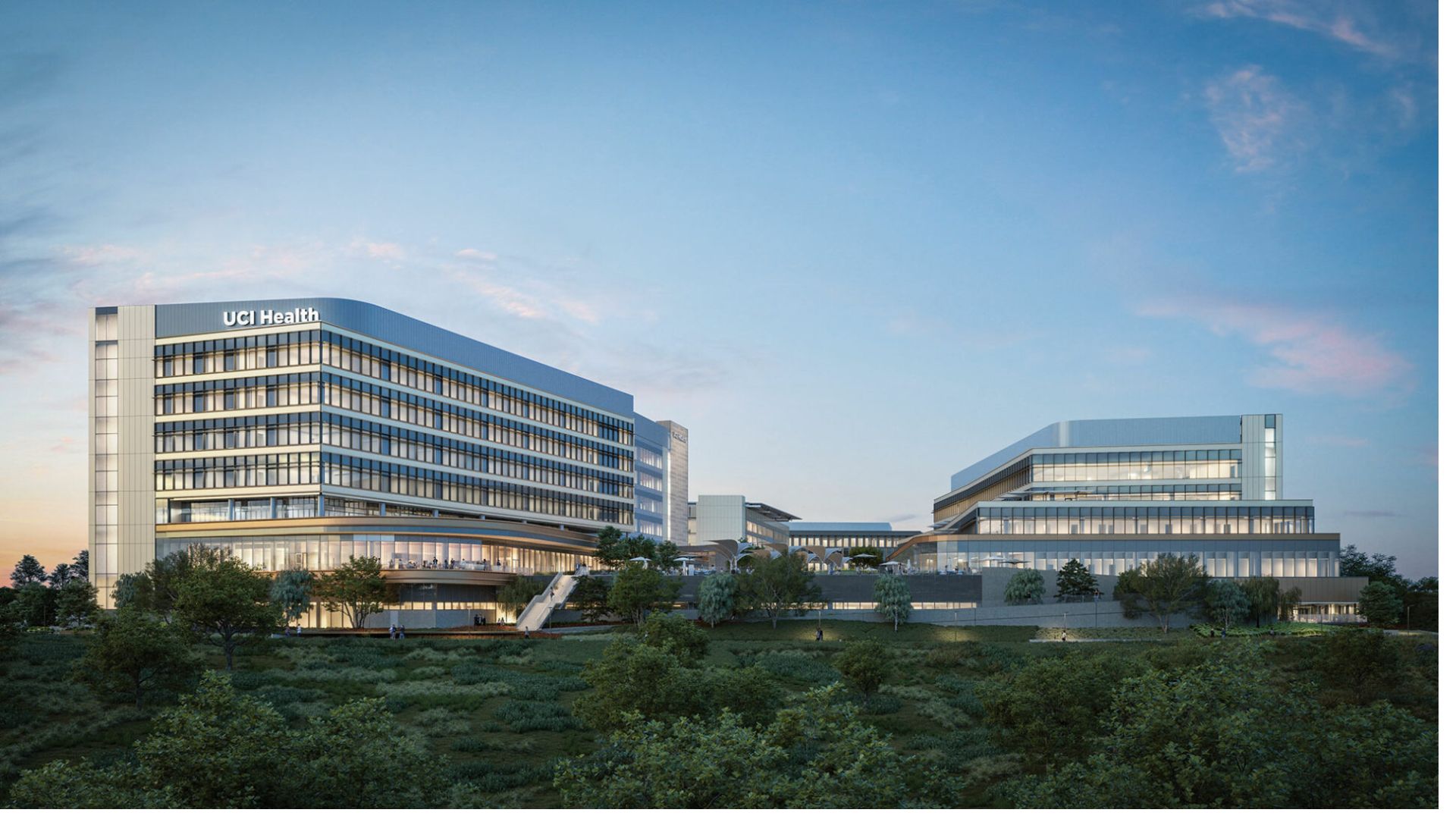
The project was completed by the progressive design–build team of CO Architects and builder Hensel Phelps. | Photo Credit: CO Architects
By Lindsey Coulter
IRVINE, Calif. — Dec. 10 marked the official opening of UCI Irvine’s new medical campus: a seven-story, 144-bed general acute care hospital — including a 20-room, 24-hour emergency department — operated entirely on electricity. Located on an 11.6-acre site, the project also comprises the 345,000-square-foot hospital and 220,000-square-foot ambulatory surgery center as well as parking structures and a central plant.
“UCI Health — Irvine embodies what it means to be a modern public research university,” said UC Irvine Chancellor Howard Gillman. “We are extending world-class, research-driven care into the community in a way that is compassionate, forward-looking and deeply rooted in this place we call home.”
The $782.7 million project was completed by the progressive design–build team of CO Architects and builder Hensel Phelps. On the main level, the emergency department — open 24 hours — sits adjacent to the arrival plaza and parking area, enabling rapid access to care. Nearby are advanced imaging facilities, including CT scanners capable of capturing detailed images in seconds and AI-enabled MRI suites designed to speed diagnosis for time-sensitive conditions such as stroke or trauma.
The physical layout was designed to minimize unnecessary movement for nurses, physicians and technicians. Short, direct pathways link the emergency department, imaging services, operating rooms and inpatient units — supporting safer and faster care and enhancing the daily workflow for staff.
The ambulatory surgery center will house outpatient surgery and procedure rooms, diagnostic and imaging services, oncology treatment and infusion facilities, clinical exam areas, a pharmacy and other support services.
The project also marks a major step forward in combining cutting-edge medical services with environmentally responsible design. Rooms are spacious and bathed in natural light, each with family space and smart technology allowing patients to communicate with care teams, access treatment information and even order meals from their beds. The design anticipates certification at the LEED Platinum level.
Perched near the protected San Joaquin Marsh nature preserve, the entire complex emphasizes sustainability and biophilic design. Inside, abundant daylight, soothing color palettes and quiet alarms are complemented by outdoor terraces, shaded walkways and healing gardens — inviting patients, families and staff to step outside.
Because of the hospital’s proximity to sensitive habitat, the design incorporates a wildlife protections such as avian-safe glass patterns and facade strategies to reduce harmful reflections, a low “turtle wall” barrier and native plant buffer that guide turtles and other species safely around the campus, and a stormwater capture and biofiltration network to clean runoff before it reaches the marsh. A 150-foot plant buffer composed of native species harvested from the adjacent marsh area further helps shield the preserve.
The hospital runs on 100 percent clean electricity, drawn from renewable energy programs and bolstered by solar panels on rooftops and parking structures. Additional sustainable systems include rainwater collection, recycled-water design and energy-efficient equipment throughout. A central utility plant operates solely on electricity and recycles waste heat to warm both the building and water — improving efficiency and reducing environmental footprint.
“Building UCI Health — Irvine as an all-electric hospital was a bold, values-driven decision,” said Chad T. Lefteris, President and CEO of UCI Health. “Hospitals are among the highest carbon emitters in the built environment, and we knew we could do better. By eliminating fossil fuels and embracing clean energy, we’re setting a new standard for sustainability in healthcare – one that protects our patients, our community and our planet. This is more than reducing emissions. It’s about creating a healing environment that reflects who we are and shapes the future of medicine.”